Your Buyer Pool Is an Asset. Manage It Like One.
Most B2B marketing reports end at the lead. A form was filled, a contact landed in the CRM, and the campaign gets judged on how many arrived and what each one cost. Everyone else who read the article, clicked the ad, or watched the video disappears from the scorecard.
That is a lot of value to throw away. For every buyer who raises a hand, many more engaged with the offer and simply weren’t ready yet. If your program can find those buyers again, they are not a loss. They are inventory.
At Hiper we call that inventory the Buyer Pool, and we treat it as the asset a Hiper Loop is built to compound. Leads are one track of growth. The Buyer Pool is the second, and it’s what lets a program keep talking to buyers across channels without paying to reach them again.
What counts as Buyer Pool, and what doesn’t
The definition matters, because a loose one turns the Buyer Pool into another vanity number.
The Buyer Pool is the set of Engaged Buyers who crossed the remarketing threshold: captured by a pixel or a platform engagement audience, so the program can reach them again without paying for discovery twice. An Engaged Buyer you cannot remarket to is not in the pool.
In practice, the pool is fed by:
- Pixels on your owned properties. Paid Publishers placements send readers to your site through tracking links, where your pixels capture them.
- LinkedIn Matched Audiences. Audiences built from the people who visited your site or interacted with your ads.
- Meta and Reddit Custom Audiences. Website and engagement audiences, which the platforms call remarketing or Custom Audiences. We call all of it Retargeting.
What doesn’t count: impressions, a purchased contact list, or anyone you can’t serve the next ad to. Reach tells you who you could talk to. The pool tells you who you can keep talking to.
Why the pool, not the lead, is the asset
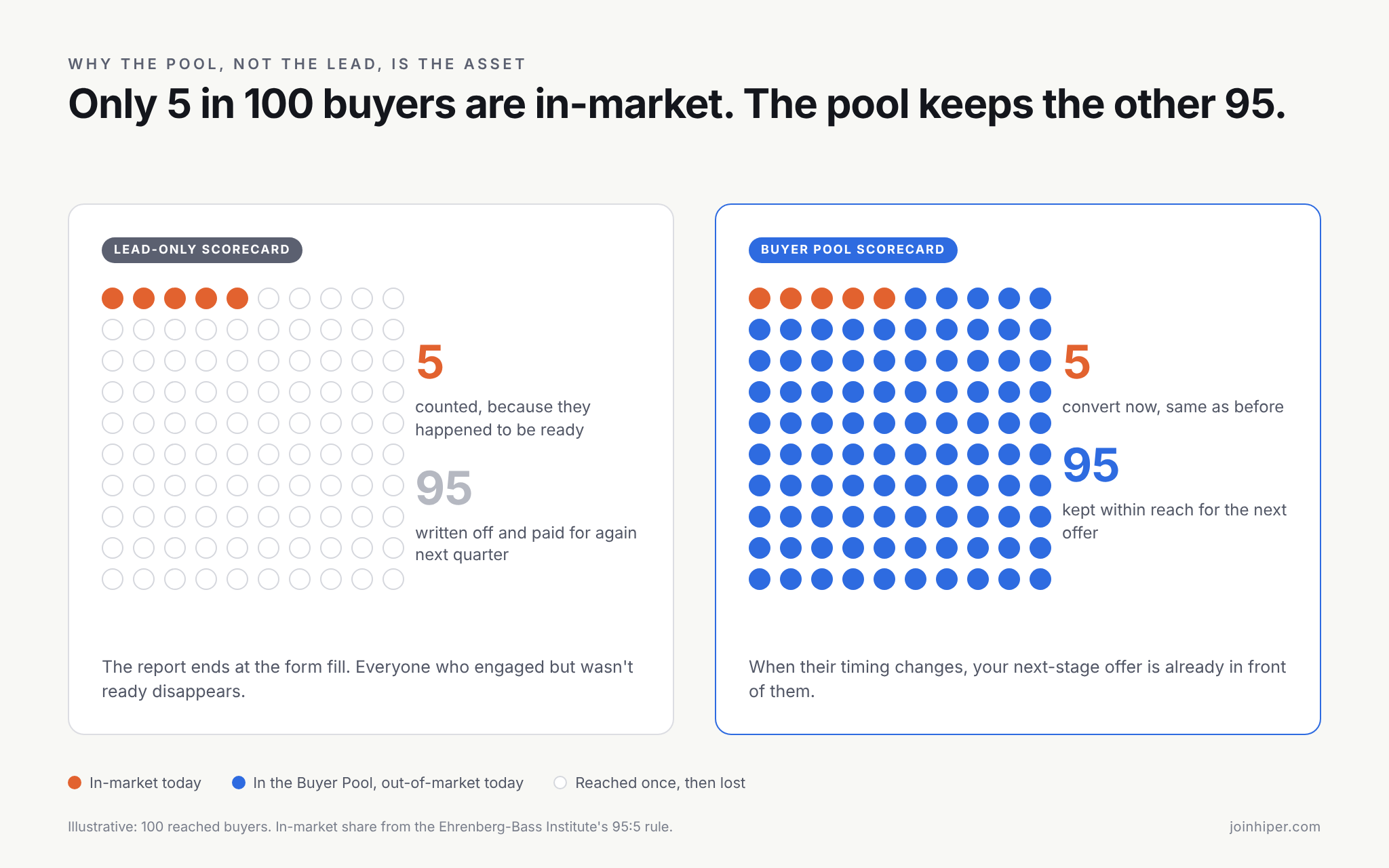
Most of the buyers you reach are not shopping today. Research from Professor John Dawes at the Ehrenberg-Bass Institute, popularized by LinkedIn’s B2B Institute as the 95:5 rule, estimates that only 5% of B2B buyers are in-market at any given time. The other 95% will buy eventually, just not this quarter.
A lead-only scorecard optimizes for the 5%. It rewards the program for catching whoever happened to be ready and writes off everyone else. A Buyer Pool keeps the other 95% within reach, so when their timing changes, your offer is already in front of them.
Timing matters more than most plans assume. 6sense’s 2025 Buyer Experience Report found that 94% of buying groups ranked their preferred vendors before first contact with a seller. The shortlist forms while the buyer is still researching quietly. A program that keeps progressing known buyers through that period earns a place on the list. A program that only counts form fills shows up after the list is written.
That is the difference between a lead and an asset. A lead is a moment. The pool is a standing audience that grows every cycle, keeps its value between campaigns, and lowers the cost of the next result.
Targeting fills the pool
Every dollar in a Hiper Loop does one of two jobs. Targeting reaches new buyers who match your Buyer Profile and grows the pool. Retargeting goes back to buyers already in the pool and progresses them to their next stage. How you divide budget between them is the Split.
Targeting is how the pool gets built, and the channels play different roles:
- Paid Publishers earn the broadest reach against the Buyer Profile at TOFU. Niche B2B publications put your offer in front of the right readers, and the tracking-link traffic lands on your site, where all three pixels capture them into the pool. This is why a new Loop starts here: it fills the pool fast.
- Paid Social is best at Targeting with TOFU offers for lead volume, and its engagement audiences add buyers to the pool directly on the platform.
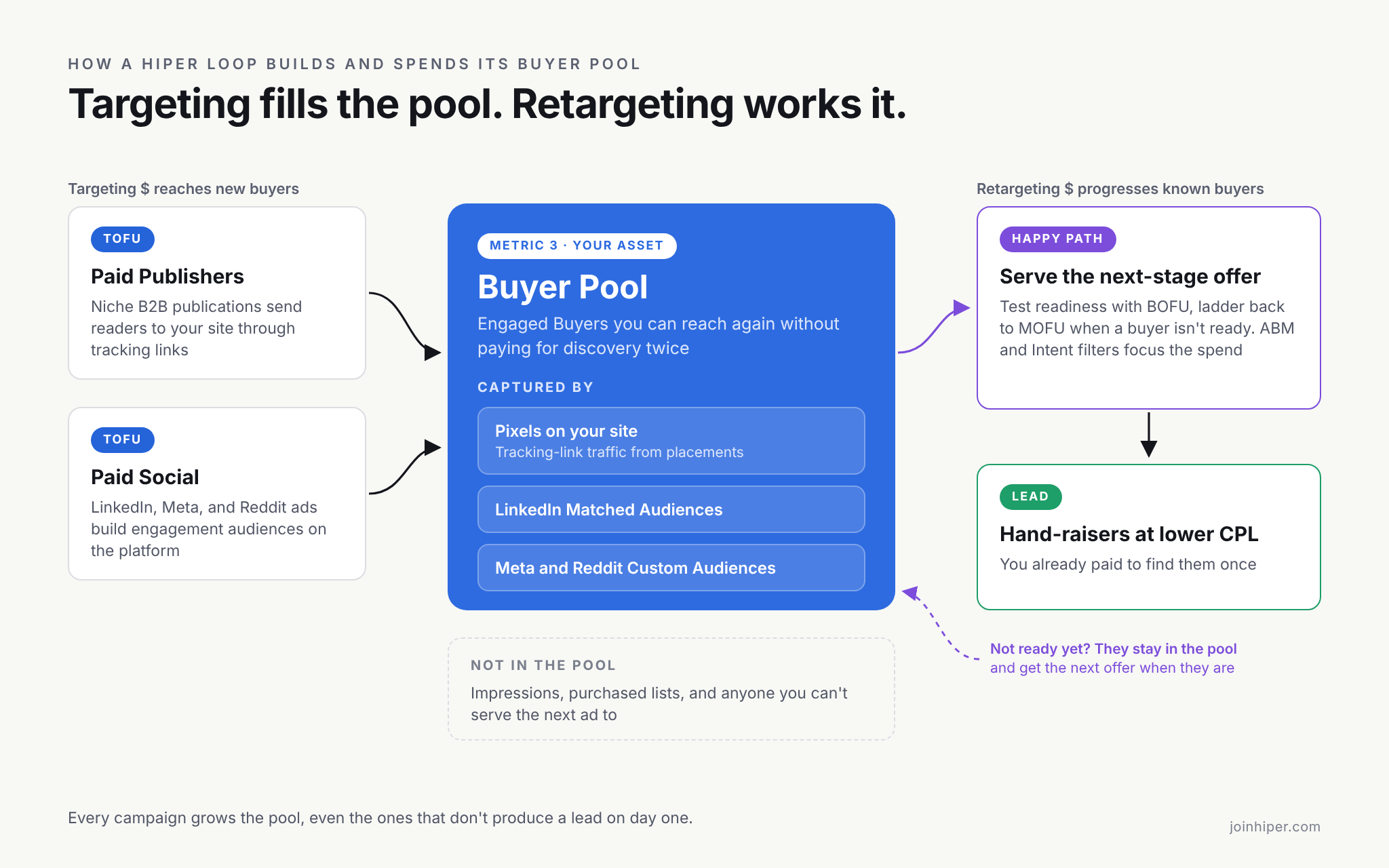
The mechanics are simple. Targeting dollars buy reach. Offer quality turns reach into engagement. Capture by a pixel or engagement audience turns engagement into pool membership automatically. That last step is why we say every campaign grows the pool, even the ones that don’t produce a lead on day one.
It’s also why Buyer Reach comes first. A pool is only as valuable as the buyers in it. If the Buyer Profile is wrong, Targeting fills the pool with people who will never buy.
Retargeting works the pool
A pool nobody works is just a list. The value shows up when Retargeting progresses buyers from Awareness to Consideration to Conversion.
In a Hiper Loop, Retargeting follows the Happy Path:
- Test readiness. When a buyer engages a TOFU offer, the Loop tests the waters with a BOFU offer to gauge hand-raising readiness. If they engage, we try to convert.
- Throttle. BOFU ads are throttled so buyers are never exhausted by conversion asks.
- Ladder. Not ready? The Loop ladders back to MOFU to rebuild interest, then returns to BOFU in a measured way.
- Rotate. Every offer runs in its own ad group with 4 to 6 clearly different variations, and new ones graduate in monthly once they beat the current ones.
ABM and Intent filters sit on top, so Retargeting spend concentrates on the accounts and buyers you care about most. This is where the pool pays back. You already paid to find these buyers once. Retargeting them with the next-stage offer produces leads at a lower CPL than reaching strangers. That only works if your offers are linked into a progression, so there is always a next offer to serve.
Read the pool like a balance sheet
An asset needs a reading routine. In Hiper’s Book of Marketing Insights (BOMI), the Buyer Pool is Metric 3, one of the metrics we control week to week. It sits between Engaged Buyers and Leads, and the health check is the ratio between each metric and the one before it.
The pool drives three of the calls you make most often:
- Buyer Pool big but Leads flat. The cheapest leads are already waiting. Shift the Split toward Retargeting.
- Buyer Pool under the floors. Below 300 matched LinkedIn members or 50,000 Reddit users, Retargeting has too little to work with. Shift the Split toward Targeting and let Paid Publishers fill the pool.
- Target accounts absent from pool growth. The pool is growing, but not where it matters. Tune the ABM lists and put BOFU weight on those accounts.
Read over time, the pool also makes the future forecastable. Buyer Pool growth, carried forward, becomes a forecastable lead and pipeline number you can plan against. That is the shift from reporting what happened to deciding what to fund next.
An asset you own
An asset only compounds if it stays with you. That’s why every Hiper Loop runs in your own ad accounts and lands on your owned digital properties. The pixels are yours. The audiences are yours. The performance data accumulates in your systems.
So the Buyer Pool, the audiences, and the performance data build up as your assets, not ours. If you ever turn a Loop off, there is nothing to hand back, because it was never anywhere but with you.
Compare that with the usual pattern. A program built inside an agency’s accounts, or on rented lists, resets when the contract ends. The next team starts from zero, pays to find the same buyers again, and relearns what the last team knew.
Ownership also changes how we get paid. After a full quarter of working together on the Collective’s best practices, a client becomes eligible for outcome-based pricing, where we charge on Buyer Pool growth and Lead growth, and on pipeline and revenue once the CRM is connected. When a vendor will price on the pool, it is telling you the pool is a real outcome, not a proxy.
What a compounding pool looks like
AWS Marketplace is the clearest example. In H1 2026, its program built a Buyer Pool of more than 1.3 million buyers in six months, alongside 5x lead growth, influenced revenue up 96.5% year over year, and CPL from $31.
Those numbers are connected. Paid Publishers and Paid Social filled the pool. Retargeting worked it on the Happy Path. Every cycle started from a bigger, better-qualified audience than the one before, so leads grew without the cost of each one climbing.
The AWS result is also a Book of Marketing Insights read out loud. Every Loop’s numbers roll into the Collective’s BOMI, the same five metrics across every Loop we run, while each client’s data stays in its own accounts. Buyer Pool growth is one of the numbers the Collective is measured on. When we raise that bar, we raise it for every Loop.
Put the pool on the plan
If your Buyer Pool isn’t on your plan, it isn’t being managed. Start with three questions:
- Can you say how many buyers you can remarket to today, by channel?
- Is that number growing every month, and is it growing in your target accounts?
- Does your Split move when the pool is big and leads are flat?
If the answers are “no,” “not sure,” and “we don’t have a Split,” your program is paying for discovery over and over. Leads tell you what this quarter produced. The Buyer Pool tells you what next quarter starts with. Build it in your own accounts, work it with linked offers, and read it every month. That is how demand compounds.

