Stop Starting Marketing From Zero
A new quarter brings a new brief. A new campaign means sourcing placements, rebuilding an audience, and writing copy from a blank page. A new agency or hire begins by learning what the last one already knew.
Each reset creates work. Too often, it also makes the team pay again for work it has already done.
Hiper’s point of view is simple: starting from zero is one of the most expensive habits in B2B demand marketing. Strong programs carry forward their offers, audiences, creative decisions, and performance lessons. Each cycle gives the next one a better starting point.
New campaigns will always need fresh thinking. The question is whether that thinking builds on what the business already knows.
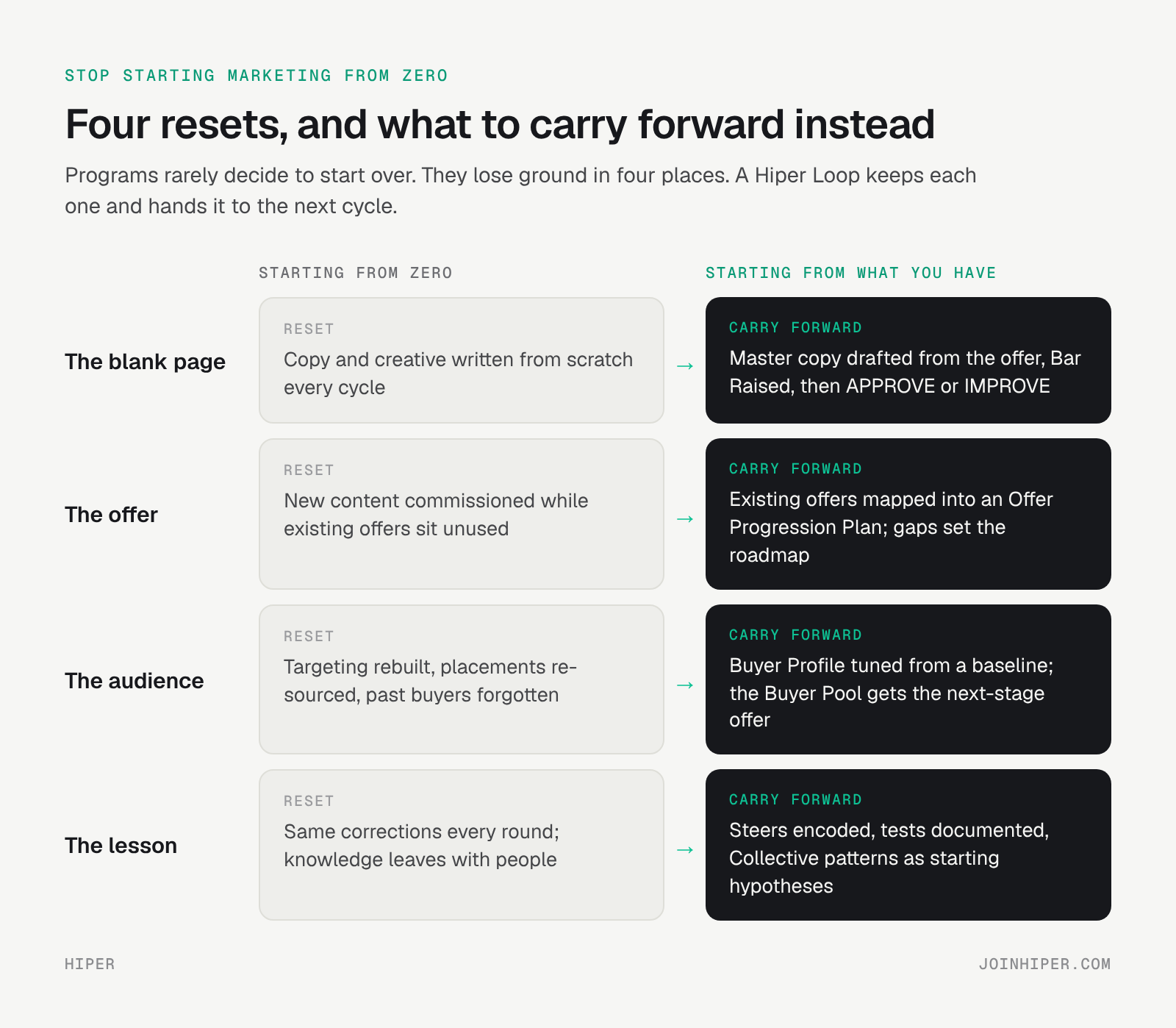
The four places programs go back to zero
Programs rarely decide to start over. Knowledge and assets get lost through everyday decisions:
- The blank page: Copy and creative start from scratch, leaving senior marketers to produce first drafts instead of improving work grounded in previous decisions.
- The offer: Teams commission new content while useful reports, guides, webinars, and customer stories sit unused because nobody has mapped the portfolio.
- The audience: Targeting gets rebuilt, placements get sourced again, and buyers reached by the last campaign receive no coordinated follow-up.
- The lesson: Feedback stays in email threads and people’s heads. The same corrections return, and knowledge leaves with an employee or vendor.
Together, these resets explain why a program can stay busy without becoming more effective.
Start from the offers you already have
Many B2B companies have more usable content than their campaign plans suggest. A report launches, gets promoted for a few weeks, and then sits on the website while the team commissions its replacement.
The first step is to understand what is already available and what each asset can help a buyer do.
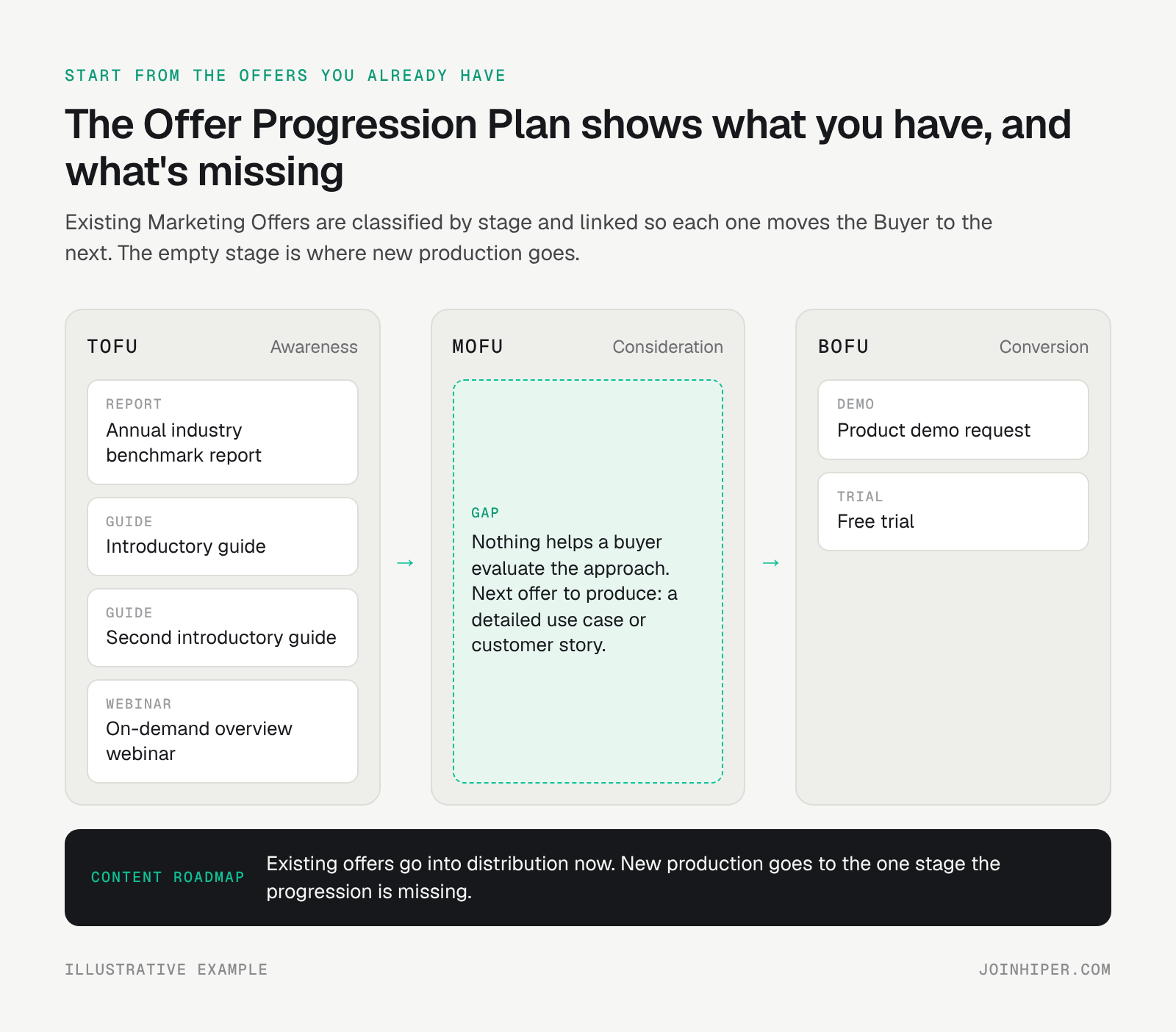
When a client joins Hiper, we inventory existing Marketing Offers: reports, guides, webinars, customer stories, demos, and other resources that give buyers a reason to engage. We assess their relevance, classify them by funnel stage, and organize them into an Offer Progression Plan for each Buyer.
The plan connects the portfolio to buyer needs across awareness, consideration, and conversion. It also exposes gaps. A company might have several introductory guides but little to help someone evaluate its approach. Another might promote a demo without giving unfamiliar buyers enough reason to request one.
Those gaps set the content roadmap. Existing offers enter distribution when they are current, relevant, and suitable for the channel; new production goes to the specific need the progression is missing.
That is why a Hiper engagement has no separate discovery phase and no kickoff deck. The Offer Progression Plan built from the client’s own site is the kickoff: a usable inventory and progression from day one, and something concrete for the team to review and improve.
Start from a draft, not a brief
Every demand program needs copy and creative. Where that work begins determines how much time the team spends getting to something useful.
A brief alone leaves much of the interpretation to the next person. A draft grounded in the actual offer gives reviewers a stronger starting point: a proposed message, a clear promise, and a call to action they can evaluate.
AI can accelerate production, but speed alone does not build that foundation. In the Content Marketing Institute’s B2B Content and Marketing Trends: Insights for 2026, about nine in ten B2B marketers reported using AI to create content, while fewer than four in ten said it had improved performance.
Producing more drafts does little to preserve what the team has learned unless the workflow carries that knowledge forward.
In a Hiper Loop, the recurring cycle of production, distribution, feedback, and improvement starts with the offer itself:
- Master copy: A core set of headlines, framing, body copy, and calls to action, drafted from what the offer actually says, becomes the source for every channel-specific version.
- Bar Raise: A senior marketer checks the message, accuracy, and strategic fit before the client sees it.
- Creative development: Designers start from a concept grounded in the offer, never a blank canvas, and build to the requirements of each channel.
- Client feedback: The client reviews Staged Ads and responds with two words, APPROVE or IMPROVE. One line of feedback regenerates the work.
The value extends beyond a faster first draft. A steer given once is encoded into the system, so the next batch starts from it and the same correction doesn’t come back in the next review round.
Senior marketers spend their time judging the work that will carry the brand’s name.
Start from the audience you’ve already built
Audience work resets in two ways: teams rebuild who they want to reach, and they lose continuity with people they have already reached.
The first starts with a durable Buyer Profile. On Hiper, this describes the audience in plain language: relevant roles, industries, priorities, and buying context. The Loop translates that description into each channel’s targeting options.
Before spending begins, the team checks whether the proposed audience has sufficient reachable scale and whether the targeting reflects the intended buyer. Hiper calls this Marketability. As results arrive, the profile and channel settings get tuned from a documented baseline, not rebuilt.
Placement decisions keep that history too. The next media plan starts from evidence about which environments reached relevant buyers and supported the program’s objectives. Our piece on paid distribution explores that approach.
The second form of continuity comes from the Buyer Pool: the audience the program can keep reaching through captured contacts and eligible remarketing audiences. Every campaign adds to that pool.
Engagement decides the next offer. When a buyer engages with a TOFU offer, Retargeting serves the next-stage offer on the Happy Path: someone who reads an introductory guide sees a detailed use case or customer story next. One interaction doesn’t make a buyer ready to buy, but it earns the next step.
The practical benefit is continuity. The next campaign builds on prior engagement while the program keeps reaching new buyers.
Start from what the last cycle taught you
The least visible reset is losing the lesson.
A team changes its offer, audience, placements, and creative at once. Results improve, but nobody can confidently explain why. The next campaign begins with another set of guesses.
Gartner’s 2026 CMO Spend Survey found that 70% of CMOs said their internal marketing processes were not mature enough to implement and scale AI effectively. Better technology still needs a process that turns activity into useful decisions.
A Hiper Loop is designed to retain learning in three ways:
- Define the test: Set the question, the variable being tested, and the success measure. Hold everything else steady during the test, then make deliberate changes between cycles.
- Record decisions and feedback: Carry approved messaging, client corrections, and performance observations into subsequent work so the team builds on them.
- Start from the Collective: Every Loop runs the same playbook, so patterns across Loops set the starting hypotheses for placements, creative, and targeting. Performance travels between Loops; your data, plans, and results never do. Those patterns still get validated for each Buyer and offer.
Consider a hypothetical program testing two guides with the same audience and comparable distribution. One generates cheaper clicks; the other produces more qualified demo requests. If the objective is qualified demand, the second guide earns the next dollar despite its higher click cost.
The next cycle tests a follow-up offer for that audience, with the original result and its limitations documented. The program has a reason for its next decision, rather than simply another asset to promote.
Learning compounds when results change what happens next.
What onboarding looks like when you build on existing work
Starting with the client’s offers and audience context gives onboarding a practical sequence:
- Inventory the offers: Review the website and client-provided materials, register usable assets, and classify them by stage.
- Draft and validate the Buyer Profile: Establish who the program needs to reach, translate that into channel targeting, and check reachable scale.
- Build the Offer Progression Plan: Map offers to buyer needs and channels, identify gaps, and review the plan with the client.
- Develop the first ads: Move selected offers through master copy, Bar Raise, design, and client approval.
- Launch and establish the baseline: Confirm account access, tracking, and campaign readiness, then begin collecting evidence for the next cycle.
Hiper’s onboarding model targets launch in roughly two weeks, subject to account readiness, usable assets, tracking requirements, and client review. The sequence makes clear what needs to happen and which inputs affect the launch date.
The AWS Marketplace program illustrates the approach at scale. Hiper’s published case study reports that demand-plan production fell from three months to three days and that the program built a Buyer Pool of more than 1.3 million people within six months. Planning speed and audience growth are distinct outcomes, but both show why the operating foundation matters.
Is your program starting from zero? Five questions
Ask these of your current program, whether it runs through an agency, an internal team, or both:
- Offers: Can you see your usable offers by buyer need and funnel stage, including the gaps?
- Drafts: Does new creative begin with approved messaging and previous feedback?
- Audience: Does the next campaign build on buyers already reached and lessons about where to reach them?
- Feedback: Are corrections recorded and applied, or repeated in every review round?
- Learning: If your agency or a key team member left tomorrow, which decisions, assets, and performance lessons would remain usable?
The answers reveal how much of each cycle survives into the next.
Give the next cycle a better starting point
Demand marketing needs room for new ideas and a reliable memory of what came before. Existing offers provide inventory. Approved messaging gives creative a foundation. Reachable audiences support follow-up. Documented tests guide the next investment.
That is the operational shift behind Agentic Demand Marketing: connecting production, distribution, feedback, and learning so the program retains more value from each cycle.
Start with the five questions above. Find the point where your program loses the most knowledge, and make that the first reset you eliminate.

