Paid Distribution Is the Future of B2B Demand
Most B2B teams budget carefully for creating Marketing Offers (the research report, the benchmark, the webinar) and treat distribution as a launch task: a company post, an email to the house list, a request for sales to share. The Offer gets a budget. Distribution gets whatever is left.
That allocation doesn’t match how B2B buyers behave. Most of the market isn’t looking for you, buyers form their shortlist before they talk to sales, and a growing share of them would rather never talk to sales at all. Under those conditions, an Offer only creates demand if it is deliberately put in front of the right buyers before they decide.
Hiper’s position: if an Offer is worth creating, it should have a funded plan for reaching the buyers it was created for. Paid distribution is how that plan gets executed.
The case in four numbers
- 95% of your market isn’t buying right now. Research from the LinkedIn B2B Institute, published by the Ehrenberg-Bass Institute, estimates that only about 5% of B2B buyers are in market at any given time. The other 95% won’t buy for months or years, and they aren’t searching for your Offer.
- The shortlist is set early. In 6sense’s 2025 B2B Buyer Experience Report, buyers chose from one of the vendors on their Day One Shortlist 95% of the time.
- Sales arrive late. The same 6sense research found buyers first contact sellers about 61% of the way through the buying journey.
- Buyers prefer to self-serve. Gartner reports that 75% of B2B buyers prefer a rep-free sales experience.
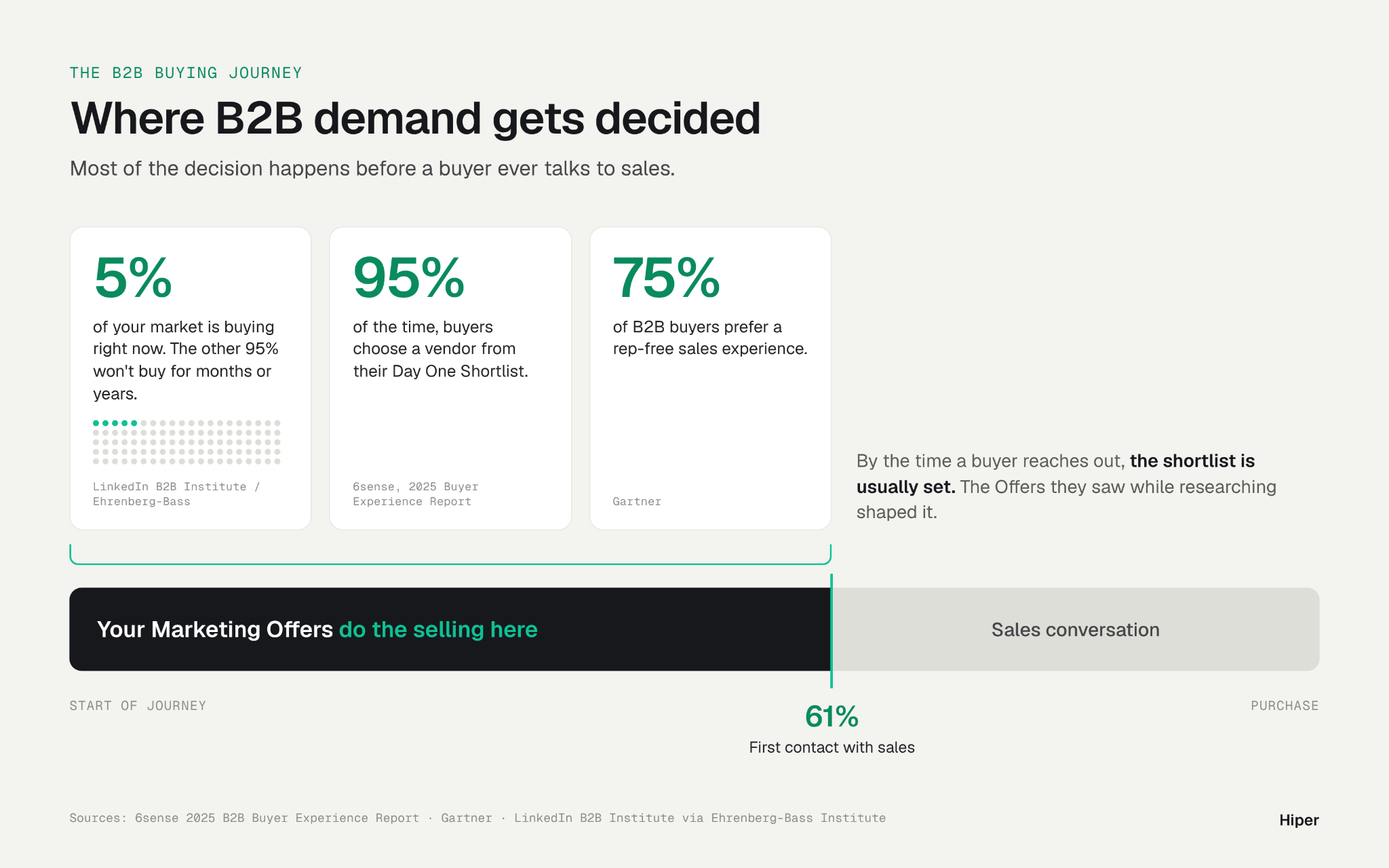
Put together, the argument is simple. The buyers who will purchase next year are mostly out of market today, they won’t come looking, and by the time they contact you the decision is largely made. Your Marketing Offers are what reach them in the meantime, but only if the Offers are actually seen. Waiting for organic discovery means waiting for the 5% who are already searching, and competing for them with everyone else.
What paid distribution controls
Organic reach is decided by someone else’s algorithm and changes without notice. Earned and owned channels still matter (our guide to content distribution strategy covers how they fit together), but they can’t be planned against a specific buyer. Paid distribution can. It gives marketers five controls:
- Who you reach. The Buyer Profile translates into each channel’s targeting: professional attributes on LinkedIn, community and interest signals on Reddit, relevant readerships in specialist publications.
- What they see. The Offer and creative are matched to the audience and the stage, not broadcast identically everywhere.
- When it runs. Exposure is scheduled around launches, event deadlines, and buying windows, and the next Offer is served after a buyer engages.
- How often. Frequency controls, budgets, exclusions, and creative rotation manage repetition.
- Where engagement lands. Every click goes to your own properties (a landing page, native lead form, or event registration), where it can be measured and followed up.
What it doesn’t control: auctions, platform algorithms, audience availability, and publisher inventory still apply, and no platform guarantees an exact number of impressions per buyer. The advantage isn’t certainty. It’s that every decision about reach and investment is explicit, and so is the read on what it produced.
Paid distribution is bigger than paid social
Buyers research across many environments, so a distribution plan has to cover more than one platform. Hiper groups the options into two Demand Channels and a set of Growth Levers.
Demand Channels
- Paid Social: LinkedIn, Meta (Instagram included), and Reddit. Reach new buyers by role and interest, and re-engage buyers who have already engaged. Retargeting has practical floors: in Hiper’s operating model, a Buyer Pool needs at least 300 matched LinkedIn members or about 50,000 Reddit users before Retargeting delivers reliably.
- Paid Media: niche B2B publications, industry media, sponsored newsletters, and dedicated email placements. Pricing varies widely: a niche newsletter slot might cost $1,200 and a dedicated eblast $12,000, so the placement mix is a function of budget, not a fixed package. For a sense of how deep this ecosystem goes, see our roundups of the top sources for cybersecurity buyers and where AI leaders learn about new technologies.
Growth Levers
- Paid Search: reaches buyers already expressing intent through a query. Match the Offer to the query: a guide for problem research, a comparison or demo for solution evaluation.
- Paid Influencers: practitioners and creators whose audiences overlap with your buyer. Audience fit beats follower count.
- Paid AEO/GEO: getting Offers cited by AI answer engines. Our piece on citation share explains why this is becoming its own discipline.
Budgets are already moving this way. Gartner’s 2026 CMO Spend Survey found digital media now represents more than two-thirds of total media investment, up 18% since 2024.
That doesn’t mean every Offer goes on every channel. Start with the environments most likely to reach the Buyer, and expand when performance justifies it.
Every channel needs a job
Paid Media and Paid Social do different work, and treating them as interchangeable wastes budget.
- Paid Media works the top and middle of the funnel. TOFU Offers earn the broadest reach against the Buyer Profile and fill the Buyer Pool. MOFU Offers run at a lower cost per lead when the Offer is strong. Paid Media never carries BOFU asks and never buys leads: the investment buys distribution of an Offer, and leads come from buyers who choose to engage. A purchased contact list is not demand.
- Paid Social works the whole funnel. It runs Targeting to reach new buyers with TOFU Offers, then Retargeting to serve the next-stage Offer to buyers who have engaged.
- Growth Levers extend the plan where they have a defined job, and each one reports on its own line so it earns continued investment on evidence.
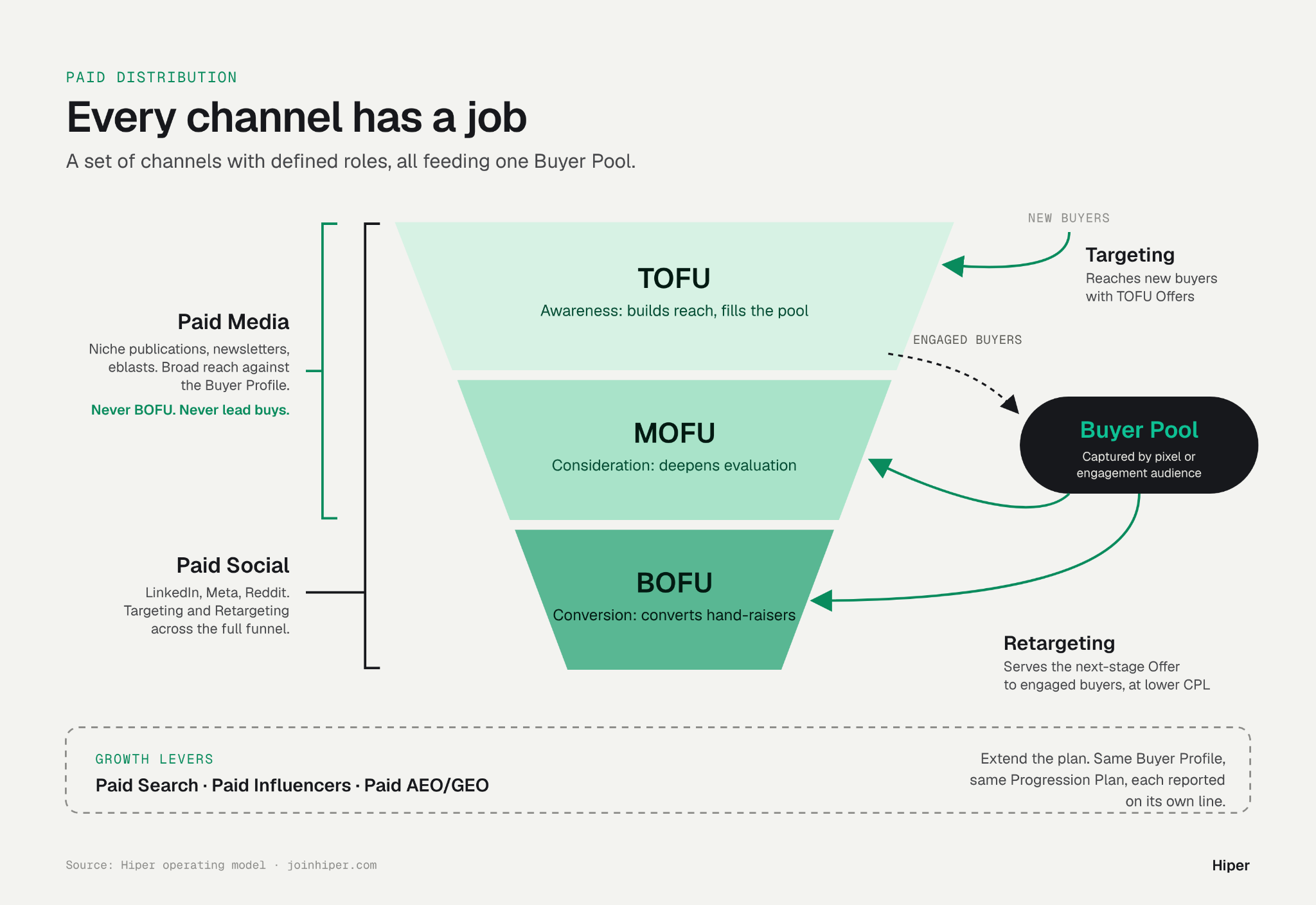
Targeting fills the pool. Retargeting works it.
When a buyer engages with a paid Offer, they can be captured by a pixel or a platform engagement audience. That puts them in the Buyer Pool: relevant buyers you can remarket to without paying to reach them cold again.
This is where paid distribution starts to compound. Targeting spend reaches new buyers and grows the pool. Retargeting spend works the pool, serving the next Offer to buyers who already know you, and it typically produces leads at a lower cost per lead than cold Targeting. Retargeting still costs money, but every dollar goes to a buyer with prior engagement instead of a stranger.
The practical decision rules follow directly:
- Buyer Pool growing but leads flat: shift budget toward Retargeting. The cheapest leads are already in the pool.
- Buyer Pool below the audience floors: shift budget toward Targeting and let Paid Media fill the pool.
- Buyers engaging with TOFU but not the next Offer: fix the follow-up Offer or its timing, not the targeting.
The funded distribution plan
If an Offer is worth creating, it’s worth funding. Before launch, the plan should answer seven questions:
- Which Buyer is this for? The role, the problem, and why the Offer deserves their attention.
- Can that Buyer be reached? Check audience sizes, publisher readerships, and inventory before a dollar moves.
- What stage is the Offer? TOFU introduces a problem, MOFU supports evaluation, BOFU invites a commercial conversation. The stage decides the channel.
- What will distribution cost? A budget by channel, set alongside the production budget.
- When will it run? Launch window, duration, and frequency approach.
- What happens next? The next Offer and the engagement signal that triggers it.
- What will we learn? The metrics that decide the next cycle.
Why it has to be a loop, not a launch
A single funded launch is better than none, but it still produces one-off results. Most programs run distribution ad hoc: new Offer, new placements, new ads, new audience, every month. When everything changes at once, there’s no clean read on what worked.
A Hiper Loop inverts that. Access to one Buyer on one Demand Channel is built once and tuned every month. Targeting, placements, and progression logic are held steady, so the variable under test is the one that matters most: the Marketing Offer against the Buyer. Each cycle reads performance and adjusts. If a newsletter placement consistently drives stronger downstream engagement, budget shifts there. If a social message underperforms, the next cycle tests a new one. This is the closed loop in practice: distribution produces signals, signals drive decisions, decisions improve the next cycle.
The evidence: AWS Marketplace
The AWS Marketplace AI Solutions program shows what systematic paid distribution produces at enterprise scale. Over H1 2026:
- Distribution mix: Paid Media across 24 to 27 niche AI publications (about $170,000 a month), Paid Social across LinkedIn, Meta, and Reddit (about $150,000 a month), and Paid Influencers (about $15,000 a month), for roughly $2.01 million in total.
- Buyer Pool: more than 1.3 million people in six months.
- Leads: over 200,000, up 381%.
- Cost per lead: $42 from Paid Media and $31 from Paid Social.
The specific numbers belong to one program. The transferable lesson is the operating approach: every Offer had a funded route to its buyers, every channel had a defined job, and every cycle built on the last.
The bottom line
Creating strong Marketing Offers is necessary but not sufficient. With 95% of buyers out of market and shortlists set before sales gets a call, an Offer that relies on organic discovery reaches too few buyers, too late.
Fund distribution with the Offer, give each channel a job, use Targeting to grow the Buyer Pool and Retargeting to work it, and run it as a loop so each cycle starts from evidence.

