The Marketing Offer Is the Unit of Modern Demand
Ask a marketing team how its demand program is organized and you’ll usually hear about campaigns, channels, or content. A Q3 launch. A LinkedIn budget. A calendar of reports, blog posts, and webinars. These are useful ways to divide up work. But they don’t answer the questions that matter to a buyer: What will I get from engaging? Why is it relevant to me? What can it help me do next?
Campaigns organize activity over time. Channels organize distribution. Content calendars organize production. At Hiper, we organize demand around the value buyers are being invited to engage with: the Marketing Offer. That gives every asset, placement, and result a common reference point. The team can see what it is offering, whom it serves, and how it contributes to the buying journey.
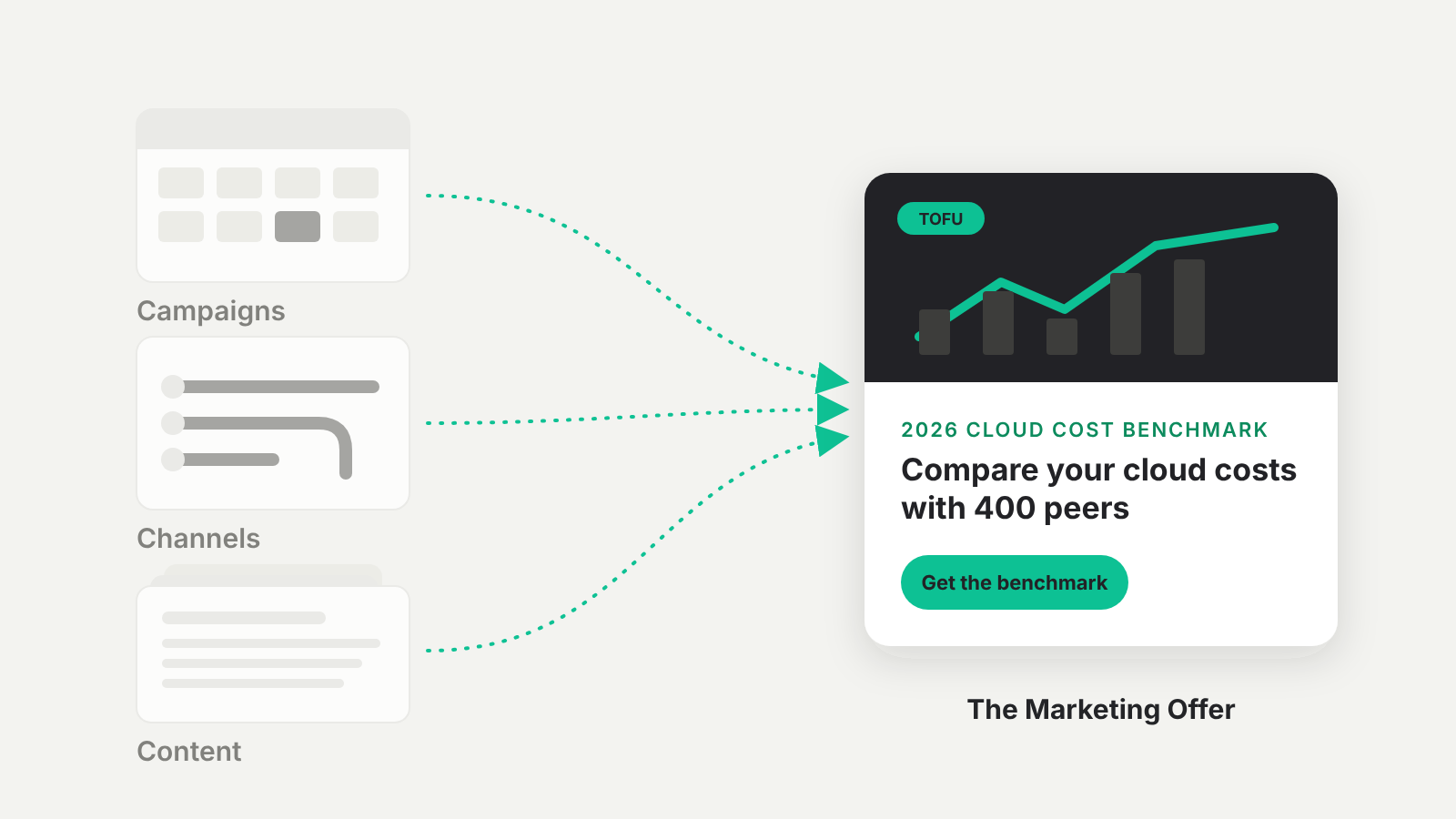
What a Marketing Offer actually is
A Marketing Offer is a specific promise of value a buyer receives in exchange for their attention, time, or information. It might be an industry benchmark, a practical workshop, a migration assessment, or a product demo. It gives the buyer a reason to engage and gives the marketing team a defined purpose for that engagement.
A useful Marketing Offer has three things:
- A promise. It explains what the buyer will gain: “Compare your cloud costs with 400 peers,” rather than “Learn about cloud optimization.”
- A destination. There is a clear way to access the value, whether through a landing page, an event registration, an interactive tool, or another measurable experience.
- A job. It addresses a particular buyer need and supports a defined step, such as recognizing a problem, evaluating an approach, or requesting help.
An Offer does not have to sit behind a form. An ungated guide or self-serve calculator can be an Offer when its value and purpose are clear. The exchange may simply be the buyer’s attention.
In a Hiper Loop, the Marketing Offer belongs to the client and draws on the client’s expertise and product. Hiper’s job is to distribute it to the right buyers and learn from their response.
Precision matters. “A webinar” names a format. “A 60-minute teardown of three Terraform drift incidents, with the runbooks attached” tells the buyer what they will get. That specificity makes the Offer easier to promote, evaluate, and improve.
Offer versus content
Content is the material: research, writing, video, or an interactive experience. The Offer defines the value that material delivers to a particular buyer and the reason to engage with it.
The same research can support a blog post, a benchmark report, and a workshop. Each can become a distinct Offer if it serves a different need. The post might help a buyer recognize a problem. The benchmark might help them assess its scale. The workshop might help them decide what to do about it.
The distinction is not whether the asset is gated. It is whether the team has defined its buyer value and its role in demand.
That changes measurement. Views and time on page can still be useful, but they need context. Did the Offer reach relevant buyers? Did engagement grow the Buyer Pool? Did buyers take a meaningful next step?
This is the shift from Marketing Output to Marketing Outcomes: from counting what the team shipped to understanding what its work helped buyers do.
Give every Offer a stage and a job
Hiper classifies Marketing Offers by the job they are designed to perform:
- Awareness (TOFU): benchmarks, research reports, practical guides, and explainers help relevant buyers recognize a problem or opportunity. Their primary job is to earn attention and grow the Buyer Pool.
- Consideration (MOFU): workshops, customer stories, ROI calculators, and maturity assessments help buyers evaluate an approach and understand its relevance to their situation.
- Conversion (BOFU): demos, trials, migration programs, and expert-led reviews help buyers take a concrete step toward evaluating or adopting the solution.
A format doesn’t fix its stage. A self-serve maturity assessment supports consideration. The same assessment delivered by a solutions engineer, with a tailored recommendation, supports conversion.
The stage also sets what success looks like. An awareness report is judged on relevant reach and engagement. A workshop is judged on whether buyers deepen their interest. A migration assessment is judged on qualified requests and the evaluations that follow.
All three contribute to business outcomes, but they should not be expected to produce the same immediate result.
No single Offer has to do everything
A strong Offer underperforms when it is asked to do the wrong job. A report gets judged only on demos booked. A demo is promoted to buyers who have not yet recognized the problem it solves. The team changes the asset when the real issue is the expectation or the audience.
Buyers do most of this work before they ever talk to sales. Gartner’s 2026 sales survey found that 67% of B2B buyers prefer a rep-free experience. The 6sense 2025 B2B Buyer Experience Report found that first seller contact occurs approximately 61% of the way through the journey, with roughly four in five purchases going to the pre-contact favorite.
Most of the preference-forming happens in that space, and connected Offers are how you show up in it with something useful.
The goal is a portfolio in which each Offer answers a relevant question and makes another useful step available.
How Offers work together
Hiper links Offers in an Offer Progression Plan, mapping the portfolio by buyer and stage. That makes gaps visible: reports with no practical follow-up, a demo with nothing building interest in it, or multiple assets answering the same question.
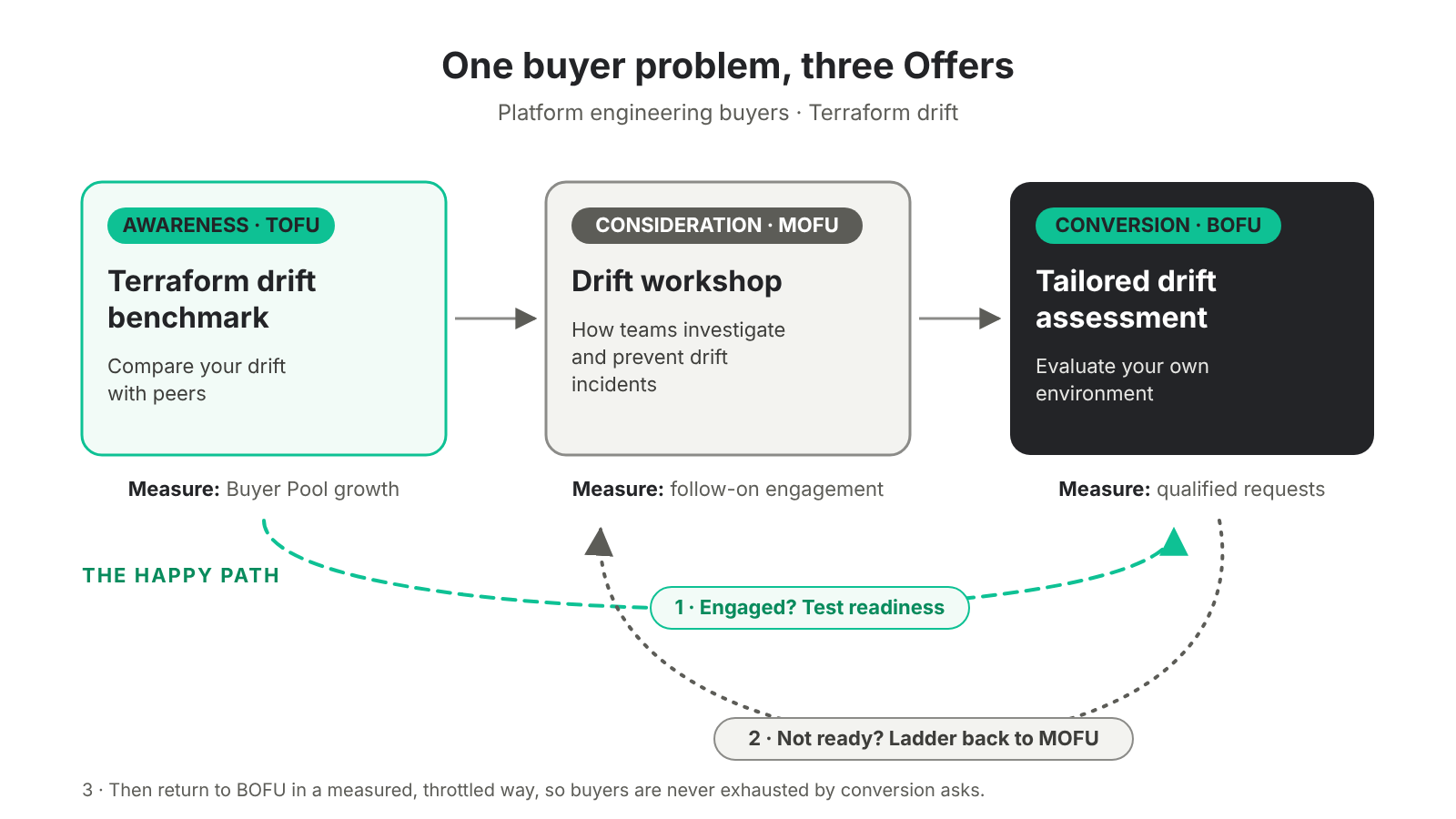
Consider an illustrative portfolio for platform engineering buyers:
- Awareness: a Terraform drift benchmark helps buyers compare their experience with peers. Measure relevant engagement and Buyer Pool growth.
- Consideration: a workshop shows how teams investigate and prevent the incidents described in the benchmark. Measure participation and follow-on engagement.
- Conversion: a tailored drift assessment helps buyers evaluate their own environment. Measure qualified assessment requests and progression into evaluation.
The connection comes from the buyer’s problem. Each Offer develops the value introduced by the previous one.
These stages describe the job of each Offer, not a mandatory sequence for every buyer. Someone discovering the benchmark may already be ready for an assessment. Someone attending the workshop may still need more evidence.
Hiper’s Happy Path accounts for that variation. After a buyer engages with a TOFU Offer, Retargeting tests readiness with a BOFU Offer. If the buyer responds, the Loop supports conversion. If they do not, it introduces a MOFU Offer before testing readiness again. BOFU delivery is throttled so buyers are never exhausted by conversion asks.
Distribution follows the Offer’s job
An Offer’s stage sets how Hiper distributes it:
- TOFU buys reach. Targeting introduces awareness Offers to audiences matching the Buyer Profile.
- MOFU blends. Consideration Offers reach new audiences and buyers who have already engaged.
- BOFU concentrates on intent. Retargeting reaches engaged buyers, and ABM account lists focus that spend on the accounts that matter most. Inclusion on a list alone does not establish readiness.
Channels divide the work too. In a Hiper Loop, Paid Media means niche B2B publication placements, used for TOFU and MOFU and never for BOFU. Paid Social, including LinkedIn, Meta, and Reddit, supports all three stages through Targeting and Retargeting.
Our guide to B2B media buying explains the publication placement side in more detail.
Why the Offer is the input
Here’s Hiper’s point of view: the Offer is the input. Everything else in the demand system should organize around getting the right Offer in front of the right Buyer at the right time.
Each part of the system serves that sentence. The Buyer Profile defines the right Buyer. The Offer’s stage and the Happy Path set the right time. Paid distribution puts it in front of them. Measurement shows how buyers respond and what to improve.
In a closed-loop system, the targeting, placements, and progression logic are held steady on purpose. That turns marketing into a controlled experiment where the variable being tested is the one that matters most: your Offer against your Buyer. When teams change the Offer, audience, placements, and creative all at once, there’s never a clean read on what drove performance.
It also changes the marketing team’s job. When production, targeting, and channel operations run inside the system, the job simplifies to three things: know your Buyer, make stronger Offers, and read the data.
The Offer becomes a durable reference point for learning across campaigns and channels. Teams can see which promises earn attention, which experiences deepen interest, and which invitations lead to qualified action.
What changes when you organize around Offers
Planning becomes more concrete. “Q1 brand awareness” becomes a defined portfolio for a specific buyer, with a purpose and distribution plan for each Offer.
Measurement becomes more useful because expectations match the job. A report does not need to generate an immediate demo request to show value, and a conversion Offer cannot succeed on clicks alone.
Learning becomes reusable. Results stay connected to the buyer need and promise being tested, even after a campaign ends.
Start by mapping what you already have. Define the buyer, promise, stage, and next step for each Offer. Identify the gaps, fund distribution, and use the response to improve the portfolio.
Campaigns, channels, and content still organize important work. The Marketing Offer gives that work its purpose. No single Offer carries the journey. Together, they move the buyer forward.

