The Economics of Demand: More Budget to Buyers, Less to Overhead
Most B2B demand budgets get judged on cost per lead. It is a useful number, but it captures only part of the economics. Long before a buyer converts, the pricing model, production workflow, and approval process have already decided how much of the budget is left to reach them.
Two programs can spend the same amount and buy very different things. One pays for repeated briefs, handoffs, and revisions. The other turns that work into a repeatable system and puts more of the budget into distribution.
Here’s Hiper’s point of view. The economics of demand come down to two questions: How much of each dollar reaches the buyers you’re targeting? And what does each cycle leave behind that makes the next dollar work harder?
Get both right and you have a credible path to a better CPL. Get either wrong and no amount of channel optimization will fix the math.
Where a demand dollar actually goes
Follow a dollar from the budget line to the buyer and count the stops: strategy, creative development, copywriting, account management, project management, reporting, and finally distribution.
Strong creative improves response, and good strategy prevents wasted spend. The question is whether the program delivers that value once and builds on it, or keeps paying to coordinate and recreate the same work every month.
The stops are multiplying. The 2026 Marketing Technology Landscape now counts 15,505 martech products, and every tool a team adds is another system someone has to connect, manage, and report from. Labor is following. Gartner’s 2026 CMO Spend Survey found that labor’s share of marketing budgets rose from 21.9% in 2025 to 24.5% in 2026, and that 70% of CMOs say their internal processes are not mature enough to implement and scale AI. Gartner reads the labor increase as a sign that AI value depends on people, skills, and execution, not just technology.
We agree, and that makes the question sharper: where does that expertise go? Senior marketers should spend their time on the Buyer, the Marketing Offers, and the calls only they can make. Repetitive production and coordination should take less of the budget every cycle, not more.
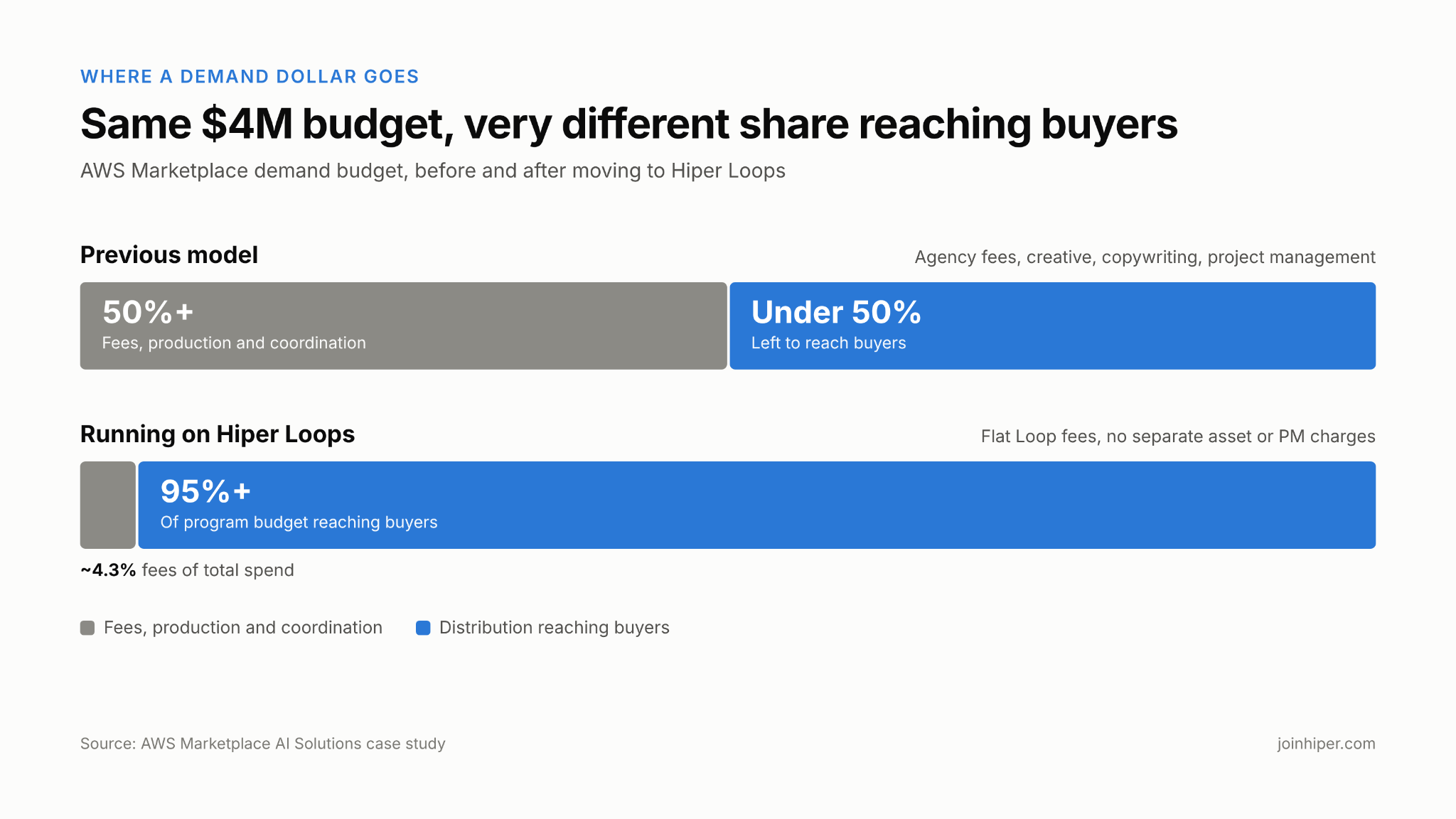
The AWS Marketplace case study shows the difference. Under the previous model, more than 50% of a $4 million demand budget went to agency fees, creative, copywriting, and project management. Running on Hiper Loops, fees came to approximately 4.3% of total spend, and more than 95% of the program budget went to reaching buyers.
That is an allocation shift, and it only matters if the extra reach produces engaged buyers, qualified leads, pipeline, and revenue.
Pricing models write the incentives
Before comparing proposals, look at what makes each partner’s revenue grow.
- Percentage of media spend: Fees rise as media investment rises, even when the work doesn’t. Efficiency works against the vendor, so ask what the higher fee actually buys.
- Deliverable billing: Every asset and revision carries another charge. Production costs are visible, but volume gets expensive exactly when a program should be accelerating, so teams ration the testing that would make it better.
- Headcount-based delivery: Capacity grows by adding people. Expertise stays valuable, but each new person adds handoffs and coordination, and the learning leaves when they do.
- A flat fee per defined unit of work: Costs are easy to forecast, and the fee doesn’t move with spend or volume.
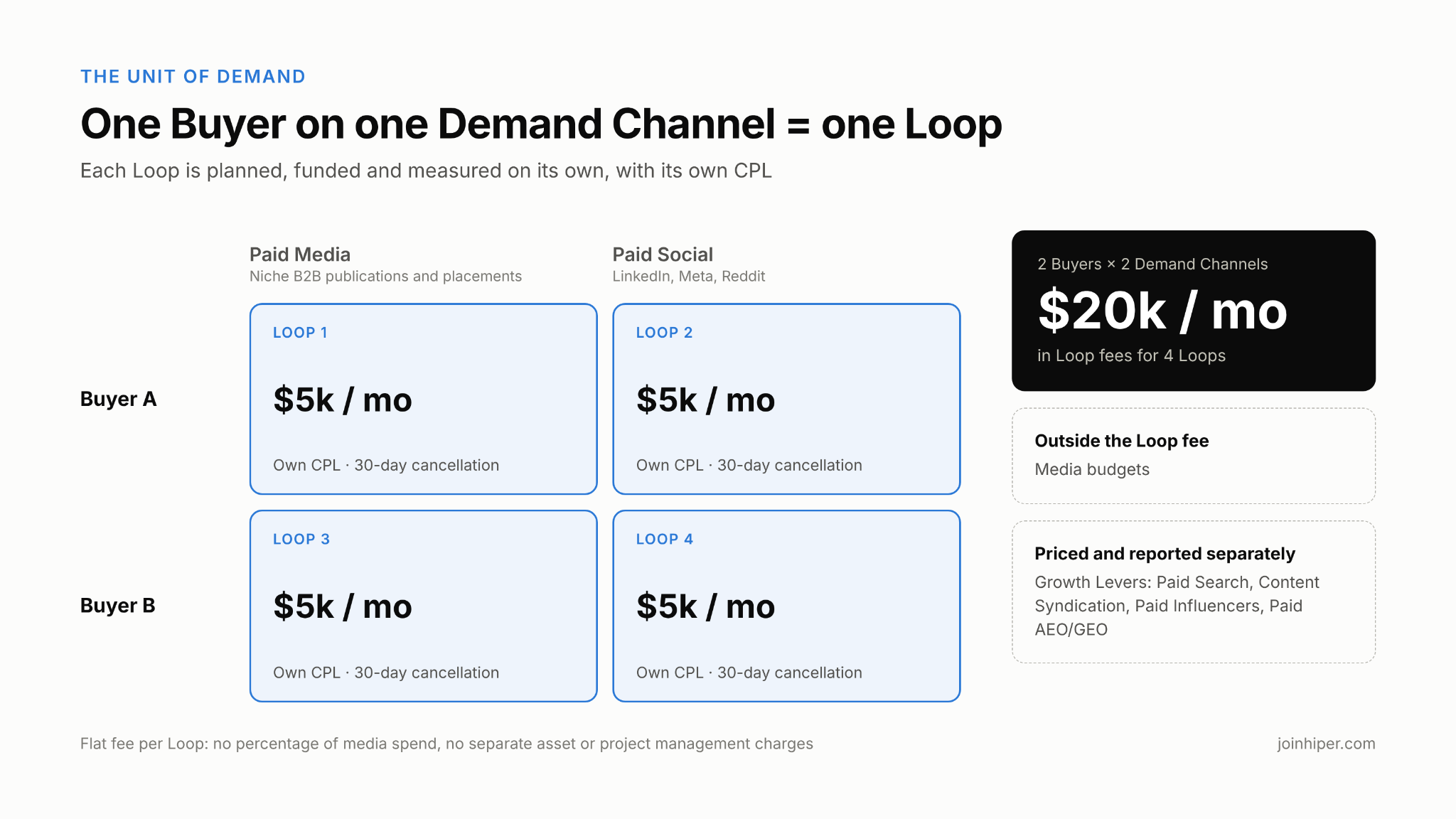
Hiper chose the last model deliberately. A Hiper Loop is one Buyer on one Demand Channel for a flat $5k per month. That is the Loop fee; media investment and separately priced Growth Levers sit outside it.
The fee doesn’t rise as a percentage of media spend, and core Loop production carries no separate asset or project management charges. That changes who benefits from efficiency. At a flat rate, every efficiency the system wins goes into media reaching your buyers, not into margin. The only way for a Loop to keep earning its place is to perform.
Make the unit of demand small and countable
Budgets get hard to manage when the smallest unit is “the agency” or “the entire program.” A blended CPL hides which Buyer or channel deserves the next dollar.
A Loop gives the budget a unit you can count: one Buyer on one Demand Channel. Paid Media (niche B2B publications and placements) pointed at a Buyer is one Loop. Paid Social (LinkedIn, Meta, and Reddit) pointed at that same Buyer is a second. Each Loop is planned, funded, and measured on its own, with its own CPL, and each channel beneath it carries its own CPL too.
The math fits in your head. Two Buyers, each served through both Demand Channels, means four Loops: $20k per month in Loop fees, plus media budgets and any Growth Levers.
Paid Search, Content Syndication, Paid Influencers, and Paid AEO/GEO are priced and reported separately, so they never blur the read on core Loop performance. And because each Loop carries a 30-day cancellation, every one of them has to keep earning its funding month after month.
What should improve with each cycle
A demand program should leave behind more than a finished campaign. Every cycle should build audience access, production knowledge, and evidence that makes the next decision better.
An audience you can activate again
Every campaign grows the Buyer Pool: everyone the Loop is able to cookie or capture and can then remarket to.
Retargeting still costs money. Its advantage is that the next-stage Marketing Offer reaches buyers who already engaged, instead of relying entirely on fresh prospecting. That is what lets a program progress buyers from Awareness to Consideration to Conversion without paying to find them from scratch each time.
The pool is an asset that needs maintenance: relevance and engagement matter more than headline size. Our piece on paid distribution in B2B demand covers how distribution builds it.
Production that keeps what it learns
In a Hiper Loop, work arrives drafted, senior marketers Bar Raise it, and you decide with two words: APPROVE or IMPROVE. One line of feedback regenerates the work, and the steer is encoded so every later batch starts from it.
The economic benefit is less repeated correction and coordination, not more drafts. Over the last two years we’ve shipped continuous improvements that raise Marketing Output efficiency and quality by 15% at a time, and five of those compound to better than 2x.
Performance knowledge that travels
Because every Loop runs the same playbook, results are comparable across Loops. The Collective sees how the same stage performs for many clients at once: which placements deliver, which creative patterns convert, which targeting holds up. That performance flows into every Loop, while your data, plans, and results never travel.
Those patterns still get tested in your context. A placement that wins for one Buyer can miss for another. What the Collective gives you is a stronger starting hypothesis and a faster path to evidence.
When the variables that should hold steady actually hold steady, the Marketing Offer becomes the thing being tested, and each cycle buys a lesson instead of a guess.
Measure efficiency without hiding lead quality
A low CPL only means something when the lead definition is clear and those buyers can progress toward a business outcome.
There is a shortcut to good-looking economics: buy the leads, pad the numbers with syndication, and let the pipeline review sort it out later. Hiper doesn’t use bought leads or syndication padding to bolster the results we report, and for that reason we don’t guarantee outcomes. We don’t recommend content syndication. When a client’s plan calls for it, we say so once, then disagree and commit: we run it well and report it on its own line, separate from the Loop metrics we stand behind.
Campaigns run in your own accounts and land on your owned properties, so Buyer Pool and Lead growth register in your systems, not on a vendor slide. That visibility should go beyond volume. Define what counts as a lead, check its quality, and separate marketing-sourced from marketing-influenced pipeline. Influenced revenue is strong evidence of marketing’s role, but it doesn’t prove marketing alone caused the revenue. Our piece on moving from attribution to marketing intelligence goes further.
What keeps the model honest is structural. Every client’s results roll into the Collective metrics we publish and own, so an underperforming Loop drags our numbers down with yours. We need your Loop to work.
For clients who want the maximum version of that accountability, outcome-based pricing is offered once eligibility is earned. After a full quarter on the best practices the Collective runs on, we can charge on Buyer Pool growth and Lead growth. Connecting your CRM unlocks pipeline and revenue tiers, because shared visibility means neither side can game the numbers.
The evidence: AWS Marketplace
The AWS Marketplace AI Solutions program is what these economics look like at scale. With more than 95% of the program budget going to audience reach, H1 2026 delivered:
- Buyer Pool: more than 1.3 million people within six months
- Leads: more than 200,000, up 381%
- CPL: $42 from Paid Media and $31 from Paid Social
- Influenced revenue: up 96.5% year over year
- Planning speed: demand plans in three days instead of three months
Those results came from offers, targeting, and placements working together, not from the pricing model alone. But the pricing model is what freed the budget to put behind them. The full case study has the investment breakdown and the rest of the results.
Five questions to ask of any demand budget
Before the next planning cycle, put these to your current model, whether it’s an agency, an in-house team, or a mix:
- Budget allocation: How much goes to distribution, and how much to strategy, production, and coordination? What does each category deliver?
- Incentives: What makes our partner’s fees go up, and does the program get better when they do?
- Unit economics: Can we read each Buyer and Demand Channel on its own, with operating costs alongside media spend?
- Compounding: What did the last cycle leave behind that improves this one: a larger Buyer Pool, faster production, or better evidence?
- Lead quality: Are lead sources and definitions clear, are any leads bought or padded, and can we connect efficiency gains to qualified pipeline and revenue?
If those answers are hard to find, that is the answer.
The bottom line
Demand economics aren’t decided in the channel. They’re decided in the model that sits between the budget and the buyer. Pay for process and you get more process. Pay for a loop that puts the dollars in front of buyers, keeps what it learns, and gets measured where it counts, and every cycle gives the next one a better starting point.
That’s the trade behind every Hiper Loop, and the reason agency-run demand is giving way to something more autonomous.

