The B2B Funnel Isn’t Dead. The Conveyor Belt Is.
Commentators periodically declare the B2B funnel obsolete. The argument is familiar: buyers conduct most of their research independently, buying groups continue to expand, and few buyers progress in a straight line from a blog post to a demo request. On this view, the funnel is a fiction that marketers should stop drawing.
The critique is partly correct. The model that many B2B teams still operate, a linear sequence that moves a lead from a gated asset to a marketing-qualified lead (MQL) to a sales development call, warrants retirement. This article refers to that model as the conveyor belt.
The funnel itself, however, is not the problem. Buyers still become aware of a problem, still evaluate alternatives, and still make a decision. Awareness, consideration, and conversion are not constructs invented by marketers; they describe how a buyer moves from no knowledge of a vendor to a signed contract. What has changed is the assumption that marketing controls the sequence in which those stages occur.
Hiper’s position is that the funnel remains valid, provided it is managed as an engineered progression rather than a pipe into which leads are poured. This requires three shifts. First, funnel stage becomes a property of each offer. Second, paid distribution determines which buyers encounter each stage. Third, a continuous loop, rather than a linear handoff, moves buyers forward.
What has changed in B2B buying behavior
Research on buyer behavior does not indicate that the funnel has disappeared. It indicates that much of the funnel now occurs outside the vendor’s view.
6sense’s 2025 B2B Buyer Experience Report found that buyers make first contact with a vendor approximately 61% of the way through their journey. By the time a buyer engages with sales, most awareness and consideration activity is complete. The same study found that roughly four out of five deals are won by the vendor the buyer favored before first contact. The funnel, in other words, still determines the outcome; it simply operates before the sales team is involved.
The adoption of AI compounds this effect. Forrester reports that 94% of B2B buyers now use AI during their buying process, which means shortlists are increasingly formed in tools that vendors neither own nor observe.
The middle of the funnel has not disappeared; it has become less visible. A model that waits for a form submission will miss most of the buying journey. A model that places relevant offers in front of the right buyers at each stage will not.
Why the conveyor belt model fails
The traditional B2B funnel was designed around a single event: the lead. Upstream activity existed to generate a form submission, and downstream activity existed to process it. This design has three structural weaknesses, each of which has become more consequential over time.
First, it treats every asset as a lead-capture mechanism. A thought-leadership report and a demo request receive the same gate and the same follow-up, which turns an awareness offer into an ineffective conversion offer.
Second, it assumes that buyers progress sequentially, one stage at a time. In practice, they do not. A buyer may read a benchmark report, remain inactive for six weeks, and then return to review a customer story and pricing on the same day.
Third, it retains no memory. When a campaign ends, every buyer who engaged without submitting a form falls out of view, and the organization pays to reach the same buyers again the following quarter.
None of these weaknesses argues against funnel stages. Each argues against operating those stages as a one-way pipe.
Funnel stage as a property of the offer
The first shift concerns where the funnel is defined. In a Hiper Loop, the funnel is not a diagram on a slide; it is an attribute assigned to every Marketing Offer.
Each of a client’s offers (a guide, a webinar, a benchmark report, a customer story, a demo) is classified as top of funnel (TOFU), middle of funnel (MOFU), or bottom of funnel (BOFU). TOFU offers build awareness and expand the Buyer Pool, MOFU offers deepen consideration, and BOFU offers convert buyers who have signaled intent. This classification is operational rather than administrative, because it determines how each offer is distributed: TOFU offers prioritize reach through Targeting, BOFU offers concentrate on intent through Retargeting and ABM, and MOFU offers combine the two.
The offers are then organized into one Offer Progression Plan per Buyer, so that each offer moves the buyer toward the next. This plan also exposes gaps in the funnel. When we apply our playbook to a new client’s existing offers, the same patterns recur: a portfolio weighted toward awareness content with no offer to convert interested buyers, or a strong demo offer with nothing feeding buyers toward it.
The result is a functioning funnel: a portfolio in which every offer has a defined role and gaps are visible. We discuss why the offer warrants this degree of attention in The Future of Demand Is a Closed-Loop System: when the Loop holds the audience, the channels, and the progression logic constant, the variable under test is the fit between the offer and the buyer.
Paid distribution determines exposure at each stage
The second shift concerns control. If buyers complete most of their research before engaging a vendor, the most reliable way to participate in that research is to determine which buyers see each offer and when. Organic reach is governed by third-party algorithms. Paid distribution is the one lever through which a vendor selects the buyers and accounts that see each offer, the platforms on which they see it, and the destination to which it leads.
Each Demand Channel serves a distinct role in the funnel:
- Paid Media (TOFU and MOFU): niche B2B publications and placements matched to the Buyer Profile. TOFU offers in this channel generate the broadest reach and expand the Buyer Pool. MOFU offers can achieve a lower CPL when the offer is strong. This channel is not used for BOFU offers or for purchased lead lists.
- Paid Social (TOFU, MOFU, and BOFU): LinkedIn, Meta, and Reddit. This channel is most effective for Targeting with TOFU offers to build volume, followed by Retargeting within the Buyer Pool. ABM and intent filters concentrate Retargeting spend on the highest-priority accounts and buyers.
This approach places every stage where buyers are likely to encounter it: the awareness offer in a niche security newsletter, the consideration offer in front of buyers who have already engaged, and the demo offer in front of warm target accounts. The mechanics of paid media are covered in our guide to B2B media buying, and the account-based layer in Turn On ABM as a Capability of Your Demand Engine.
The Buyer Pool as the funnel’s memory
The conveyor belt model discards every buyer who does not submit a form. A modern funnel retains them.
The Buyer Pool consists of every buyer captured by a pixel or a platform engagement audience who can be reached again without incurring the cost of discovery a second time. Leads who submit forms represent one dimension of growth. The Buyer Pool represents a second, and it is the dimension that allows the funnel to function when buyers remain anonymous for most of their journey.
This is how the model addresses the dark funnel without claiming visibility it does not have. A vendor cannot know every question a buyer posed to an AI assistant. A buyer who engaged with a TOFU offer, however, enters the pool, and the Loop can continue to present the next relevant offer. The AWS Marketplace case study illustrates the cumulative effect at scale: a Buyer Pool of more than 1.3 million in six months.
The Happy Path: progression without a straight line
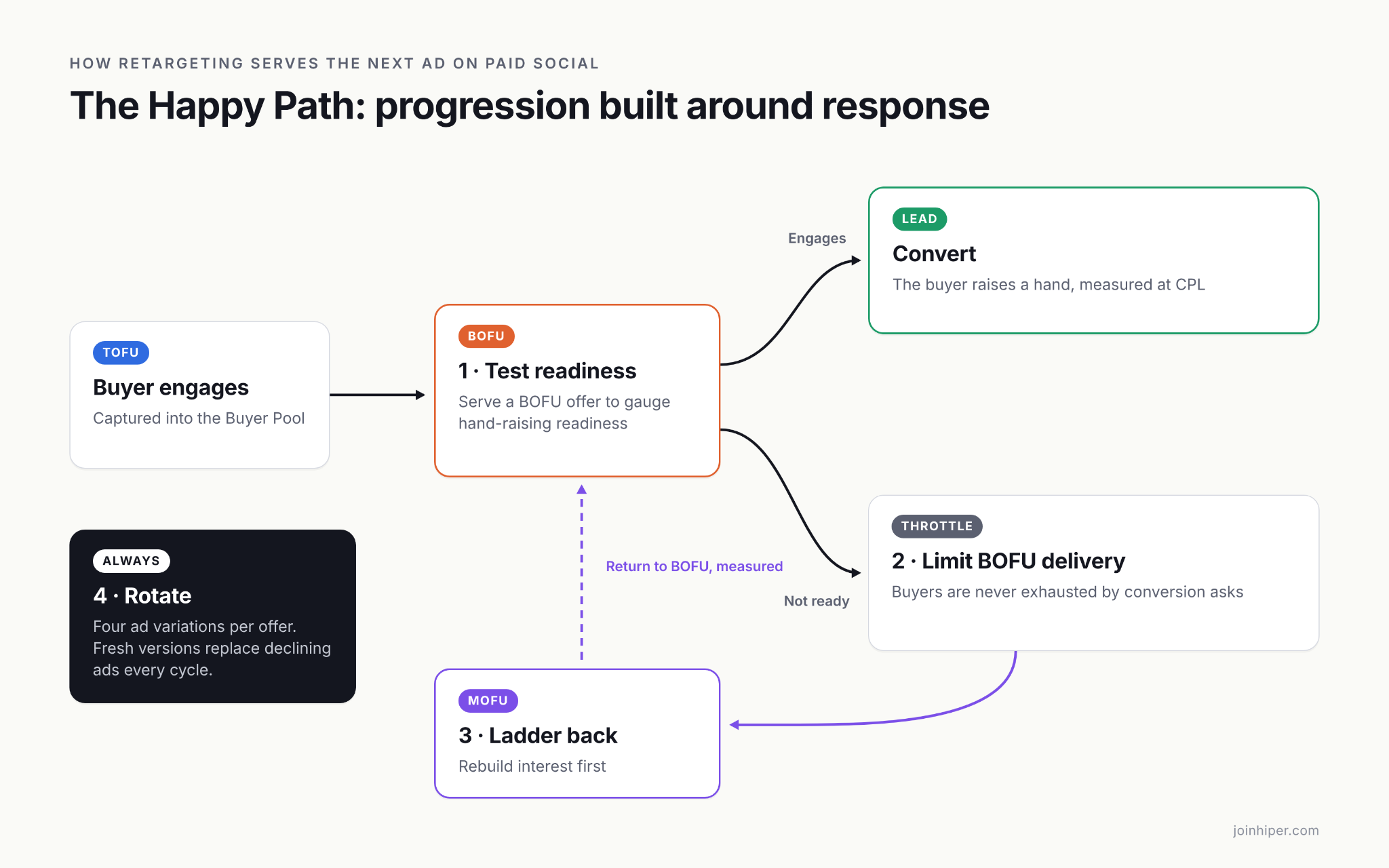
The third shift concerns how buyers move between stages. On Paid Social, Retargeting follows a sequence we call the Happy Path, which is intentionally non-linear:
- Test readiness: when a buyer engages with a TOFU offer, the Loop introduces a BOFU offer to assess the buyer’s readiness to raise a hand. If the buyer responds, the Loop pursues conversion.
- Throttle: BOFU ads are frequency-limited so that buyers are not overexposed to conversion requests.
- Ladder: if the buyer is not yet ready, the Loop returns to MOFU offers to rebuild interest, then reintroduces BOFU offers in a measured, controlled manner.
- Rotate: each offer carries four ad variations, and each cycle introduces new versions, so that no single ad is overserved.
Because buyers do not progress linearly, the funnel should not require them to. The stages remain; the sequence becomes responsive to buyer behavior.
Measuring the funnel as a single system
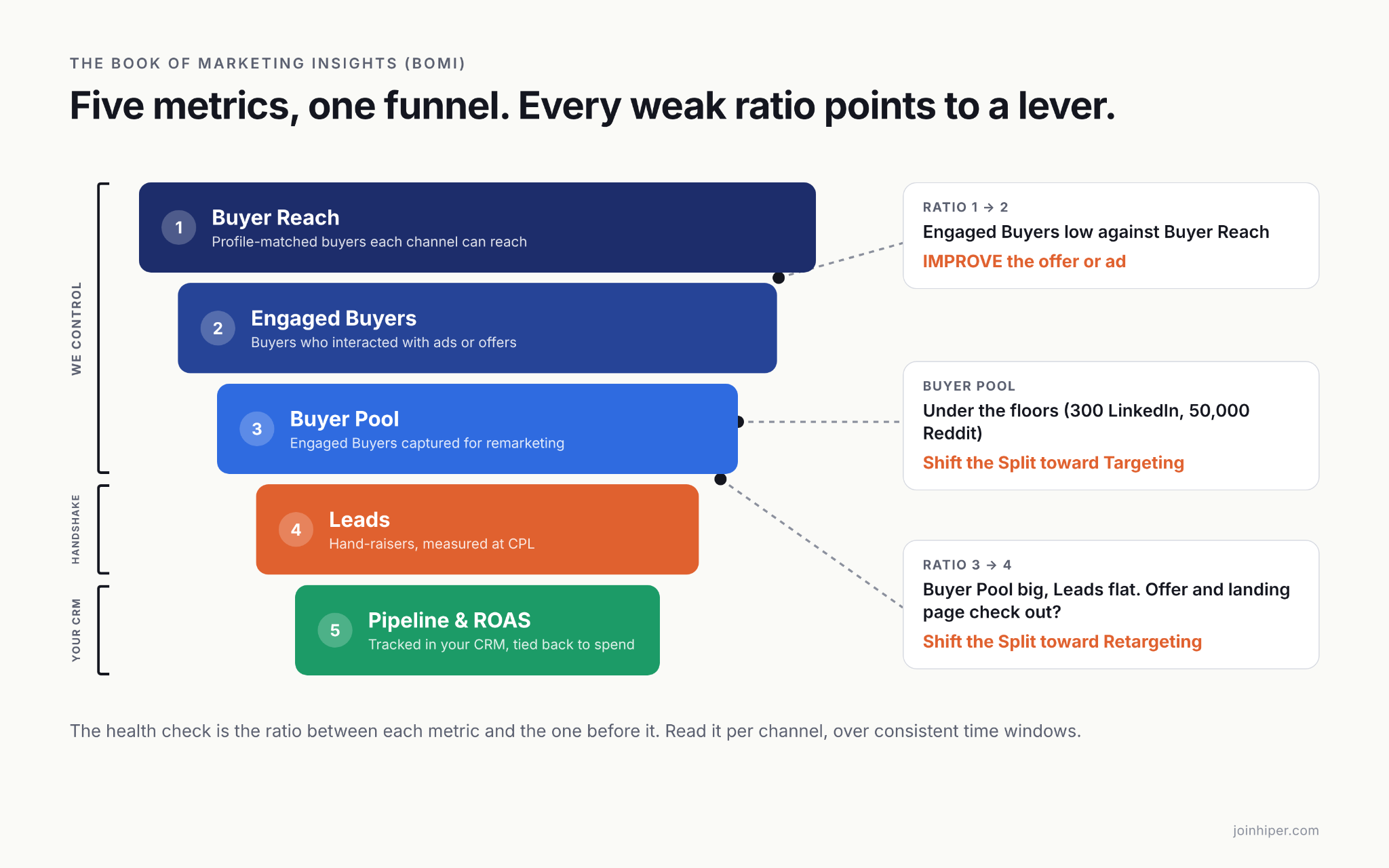
A funnel that cannot be measured end to end tends to produce disputes between marketing and sales over which figures are authoritative. We use the Book of Marketing Insights (BOMI) to read the entire funnel in a shared vocabulary of five metrics:
- Buyer Reach: the number of profile-matched buyers each channel can reach.
- Engaged Buyers: buyers who interacted with the ads, from clicks to lead form opens.
- Buyer Pool: engaged buyers captured so that the Loop can reach them again.
- Leads: buyers who expressed explicit interest, measured by cost per lead (CPL).
- Pipeline and ROAS: the pipeline those leads generate, measured in the CRM and attributed to the offers, placements, and spend that produced it.
The principal diagnostic is the ratio between each metric and the one preceding it, and each weak ratio corresponds to a specific lever. A low ratio of Engaged Buyers to Buyer Reach indicates that the offer or creative requires improvement. A large Buyer Pool with flat lead volume indicates that the Split should shift toward Retargeting, because the lowest-cost leads are already in the pool. A Buyer Pool below its minimum thresholds indicates that the Split should shift back toward Targeting. We examine how to translate these readings into action in From Attribution to Marketing Intelligence, and how to distinguish sourced from influenced results in Marketing-Sourced vs. Marketing-Influenced Pipeline.
This model does not measure a single conversion event. It measures progression, including the buyers the conveyor belt model ignores.
Why the loop sustains the funnel
A funnel operated as a one-time campaign decays: ads lose effectiveness, audiences fatigue, and each quarter begins from zero. Each cycle of a Hiper Loop instead begins from the performance of the previous one, including conversions, placements, platforms, and the lessons of prior cycles. Underperforming ads are replaced, successful ads receive new variations, and buyers progress to the next stage. Because every Loop runs the same playbook, what works at one stage in one Loop informs every Loop in the Collective. The conveyor belt is built once and degrades over time; a Loop is built once and refined with every cycle.
The funnel, revised
The B2B funnel, then, is not obsolete. The comparison below contrasts the conventional model with the revised approach:
- Stages: a diagram on a slide becomes an attribute of every Marketing Offer.
- Sequence: a one-way pipe becomes an Offer Progression Plan, executed through the Happy Path.
- Reach: dependence on form submissions becomes paid distribution at every stage.
- Memory: a static lead list becomes a Buyer Pool.
- Measurement: a single conversion event becomes five BOMI metrics, read as one funnel.
Those who declare the funnel obsolete are generally describing the conveyor belt model they inherited. Buyers have not stopped moving through stages; they have stopped waiting for vendors to move them. The task now is to be present at every stage deliberately, with the appropriate offer, and to improve with every loop.
Organizations that want to understand how their current offers map to the funnel, and where the gaps lie, can join Hiper; we will build an Offer Progression Plan from the offers already live on their site.

