Buyer Reach Comes First: Validate the Audience Before You Spend
Most B2B demand dashboards open on one of two numbers: what you spent, or how many leads came back. Both matter. Neither answers the question that should come before launch: can your channels reach enough of the right buyers to support the program?
That question is Buyer Reach, and at Hiper it’s the first metric in the funnel. Before launch, it’s the estimated audience each channel can address with the targeting available for your Buyer Profile. After launch, it’s the baseline we read delivery, engagement, and Buyer Pool growth against.
An estimate isn’t proof that anyone saw your offer. But it’s the only number you can know before a dollar moves, and it’s where the most expensive mistakes are cheapest to fix.
Why Buyer Reach belongs at the start
In Paid Distribution Is the Future of B2B Demand, we argued that paid distribution is the one lever where you decide who sees your offer. In The Marketing Offer Is the Unit of Modern Demand, we argued that the offer is the variable worth your team’s best thinking.
Buyer Reach connects the two. A strong offer delivered to people with no reason to care will fail. A relevant audience shown a weak offer will fail too. You can only tell those problems apart if you checked the audience first.
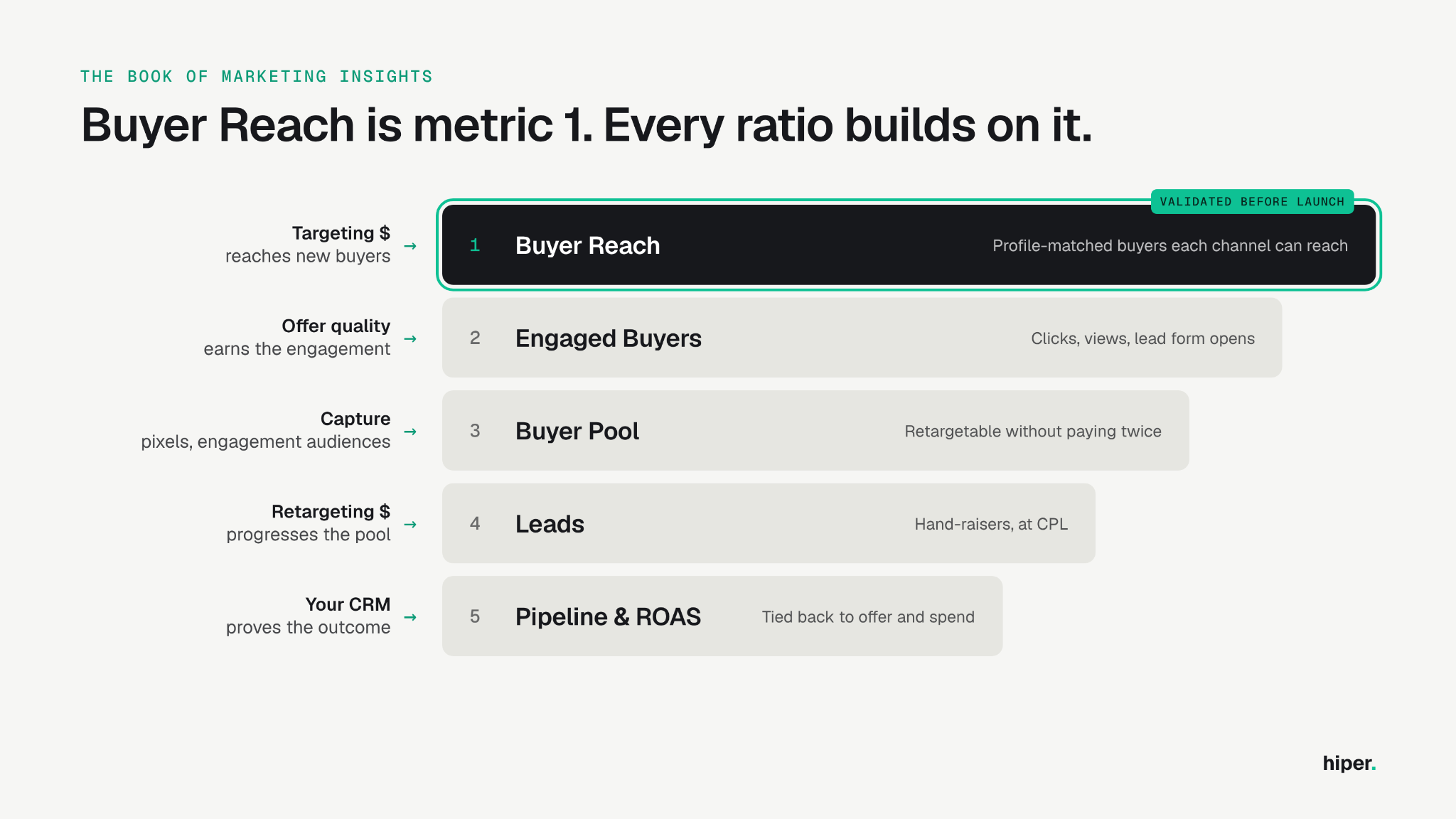
That’s why Buyer Reach is metric 1 in Hiper’s Book of Marketing Insights (BOMI), the five-metric funnel every Hiper Loop is read against:
- 1. Buyer Reach: the profile-matched buyers each channel can reach
- 2. Engaged Buyers: buyers who complete an on-ad action, such as a click, a video view, or a lead form open or submit
- 3. Buyer Pool: Engaged Buyers captured by a pixel or engagement audience, so you can retarget them without paying for discovery twice
- 4. Leads: buyers who raise a hand, measured at CPL
- 5. Pipeline and ROAS: what Leads become in your CRM, tied back to the offers, placements, and spend that produced them
Individual buyers don’t march through those stages in lockstep. Some convert on the first touch; others need several offers. But the money moves in a fixed order. Targeting dollars reach metric 1. Offer quality converts 1 to 2. Capture turns 2 into 3. Retargeting dollars work 3 to 4. Your CRM proves 4 to 5. If you skip the first step, every ratio after it sits on an unknown denominator.
Impressions aren’t buyers
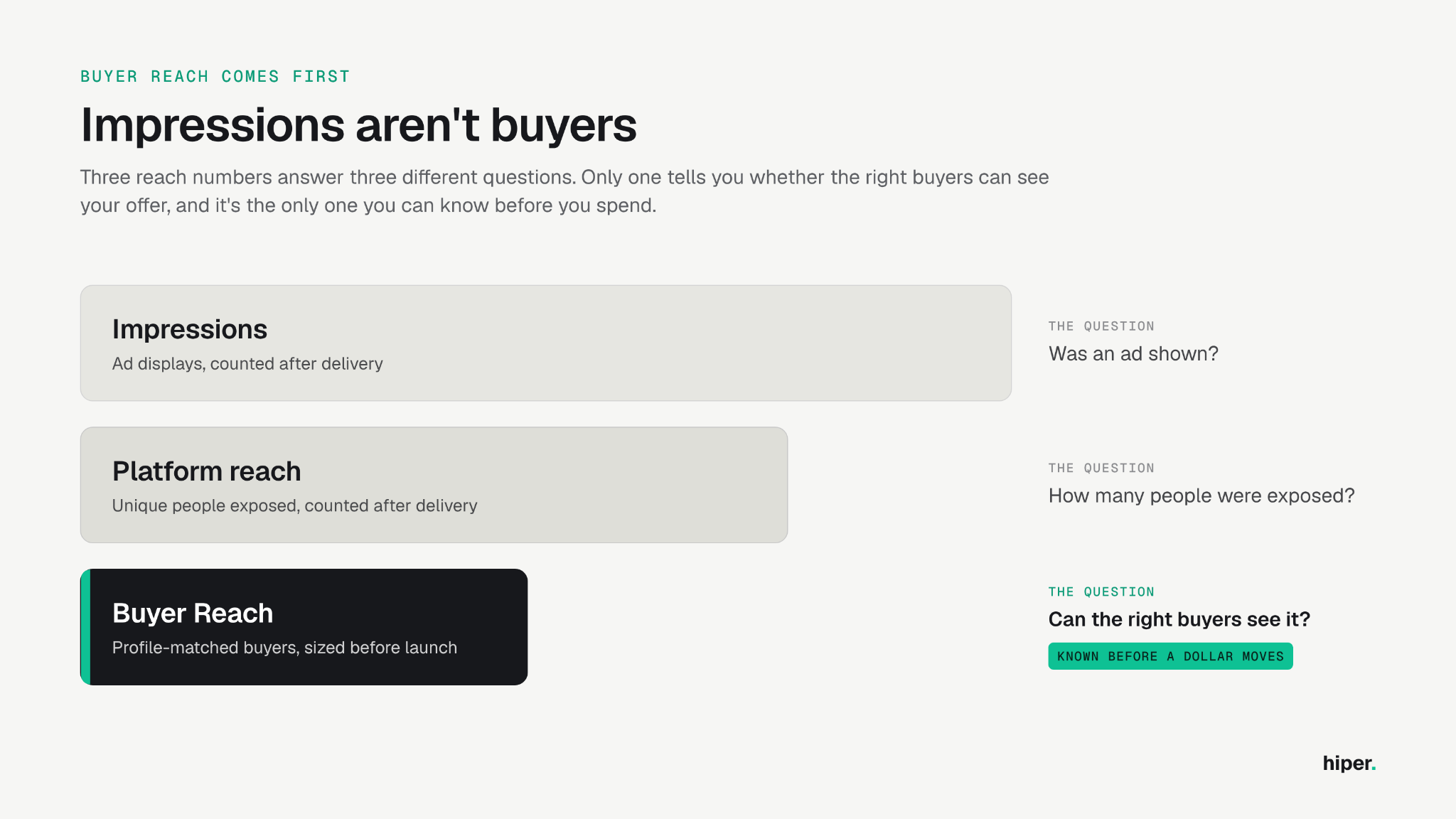
The industry already has a reach number. It’s called impressions, and it measures delivery, not buyers.
The gap is bigger than most teams assume. The ANA’s Q4 2025 Programmatic Transparency Benchmark found that advertisers with disciplined quality governance converted 56.7% of programmatic spend into impressions that were fraud-free, measurable, viewable, and free of made-for-advertising sites. Lower performers converted 37.5%. Even the best lost more than 40 cents on the dollar before anyone asked whether the impression reached the right person.
Platform reach counts unique people exposed. Neither tells you whether those people fit your Buyer Profile. Buyer Reach asks that question directly, channel by channel, and each channel answers it with a different level of confidence:
- LinkedIn: Target audience size against professional attributes (titles, seniority, company size, industry). The strongest signal for who someone is at work.
- Meta and Reddit: Estimated audience size and Audience size, built on interest, community, and engagement signals. Real scale, but thinner evidence of job role, so judge the proxies as carefully as the number.
- Niche B2B media: placement circulation. A starting point, not a count of verified buyers. Audience composition and placement context matter as much as the total.
Read each channel on its own. Adding the sizes together double-counts anyone who uses more than one platform.
Buyers decide before they talk to you
Reach matters more now because buyers make more of the decision on their own. Gartner reports that 75% of B2B buyers prefer a rep-free sales experience. The shortlist forms in research, peer conversations, publications, and AI answers long before a form fill tells you anyone was looking.
So distribution has to be present while buyers form a view and won’t tell you. A program that only measures leads is measuring the last moment of a decision it never saw. A program that measures Buyer Reach first knows whether it was in the room.
Validate the audience before launch
Every Hiper Loop starts with Marketability: the pre-spend proof that there’s real reach behind the Buyer Profile and that targeting is applied correctly. A profile without reach behind it doesn’t pass the Bar Raise, and nothing runs until it does.
1. Describe the Buyer once, in plain language. Industry, company size, geography, unique signals, and job titles laid out as an org chart: Core Buyer, Approver, Champions, Influencers. Titles need care. Companies use different titles for the same job, and a profile built on one exact title excludes real buyers before the campaign starts.
2. Ground it in truth. Apollo and ZoomInfo check that the companies, titles, and signals exist in the market. That validates the profile’s assumptions. It doesn’t guarantee every channel can find the same people.
3. Size it on each channel. Pull the audience estimate for the exact targeting, and record the settings and date. Where supported, our MCP retrieves these sizes live, so revisions take minutes. Where a channel can’t target a role directly, name the proxy signal and why it fits.
4. Review fit, scale, and budget together. An audience can be relevant but too small for the planned spend. It can also be big enough to absorb any budget while offering weak evidence of fit. A large number alone doesn’t pass.
Take a hypothetical infrastructure software campaign. Targeting one exact engineering title produces a thin audience. Adding the equivalent titles improves coverage without changing the buyer. Dropping the industry filter expands it further but weakens relevance. The right adjustment is the one that improves access while keeping the reason those people would care.
You find out the audience is wrong during planning, when the fix costs a sentence in a Buyer Profile instead of a quarter of budget.
When reach is weak, fix the profile, not the budget
When Buyer Reach comes back small, the instinct is to blame the channel or add budget. Neither helps, because the platform is only reporting how many people match what you asked for.
The lever is the Buyer Profile. Our rule: when Buyer Reach is too small on a channel, improve the profile and re-pull sizes until reach is strong, or let another channel carry that layer. Three checks cover most cases:
- Titles too narrow? Add the real variations in naming and responsibility, then re-size.
- Filters stacked too deep? Remove the restriction doing the least work for fit.
- Wrong channel for this layer? Some buyers are thin on one platform and dense on another, or best reached through a specialist publication.
Sometimes small is correct. A focused account program has a limited buyer universe, and the right answer is a smaller budget, a different offer sequence, or another channel, not a broader definition of the buyer.
Keep prospecting audiences and retargeting audiences separate in your head. LinkedIn requires at least 300 members before a retargeting audience can be used, and Hiper sets its floors at 300 matched LinkedIn members and 50,000 Reddit users. Those floors make an audience usable, not strong. When the Buyer Pool sits under them, shift the Split toward Targeting and let Paid Media fill it.
Bigger isn’t the goal. Relevant access is.
The opposite failure is widening targeting until the estimate looks impressive.
That’s why the Buyer Profile is built around Motive: whose job is on the line for the technology, and who gets the promotion when the project goes well. It separates Technical Decision Makers from Business Decision Makers, because they often need different offers. An engineer responds to an implementation guide. A business leader needs the cost, risk, and operational case. Reach to the wrong half of the org chart inflates the number and starves the funnel.
On Paid Media, the same discipline drives placement selection. Hiper shortlists from thousands of niche B2B placements, filtered to your Buyer and your offers’ funnel stages, then optimized across audience alignment, availability, and budget, with enough reach left for the buyers you didn’t know to target.
After launch, the estimate becomes a hypothesis
Once campaigns run, Buyer Reach becomes the baseline you test against, and BOMI turns the reads into direct calls:
- Buyer Reach too small on a channel: improve the Buyer Profile, or let another channel carry that layer.
- Engaged Buyers low against Buyer Reach: the offer or the ad needs work. IMPROVE.
- Buyer Pool large but Leads flat: shift the Split toward Retargeting. The cheapest leads are already waiting.
- Buyer Pool under the floors: shift the Split toward Targeting.
- Target accounts missing from Pool growth: tune the ABM lists (more in Turn On ABM as a Capability of Your Demand Engine).
None of those calls work if you don’t trust the first number. We cover how measurement turns into decisions in From Attribution to Marketing Intelligence.
Reach compounds inside a loop
Most programs run ad hoc: new offer, new audience, new placements every month, and never a clean read on what worked. A Hiper Loop builds access to the Buyer once and tunes it every cycle, with Buyer Reach feedback in the loop. Holding the audience steady means the variable being tested is the one that matters: the Marketing Offer against the Buyer. When targeting does change, document it, so a jump in engagement isn’t credited to new creative by mistake.
Over time, Buyer Pool growth becomes a forecasting input, read alongside historical conversion rates, offer relevance, and budget. That’s how AWS Marketplace built a Buyer Pool of 1.3M in six months, with more than 95% of budget reaching buyers instead of production overhead.
Start with the number that comes first
Spend tells you what you paid. Leads tell you who raised a hand. Buyer Reach tells you whether the right buyers could have seen your offer at all, and it’s the only one of the three you can know before you spend.
Ask three questions of your current program:
- Have you sized the audience for your actual targeting, channel by channel?
- Do you know how reliably each channel identifies your buyer, and which proxies you’re trusting?
- When reach came back weak, did you change the profile, or the budget?
Fix those first. Every other number in your funnel is a ratio built on this one, and it’s the right foundation to measure marketing effectiveness from.

