Decisions, Not Production: Run Your Demand Program With Two Words
This article describes how client review works in a Hiper Loop: what the client sees, at which stage, what each response does, and how feedback carries into later work. The model rests on one principle. Senior marketers add the most value when they make decisions on finished work, not when they manage the production of it.
The problem: senior time spent managing production
Senior marketers are hired for their judgment, but a large share of their week goes to production management: writing briefs, marking up drafts, repeating feedback, and chasing sign-off.
Optimizely’s 2026 research on UK marketers found that slow approvals were the most frequently cited source of unnecessary work, named by 38% of respondents. The same study found that 45% spend at least a quarter of their working week on low-value admin.
Additional drafting capacity does not address this constraint. More drafts produce more review. The constraint is the client’s role in the workflow.
The standard brief-and-markup cycle shows why. A brief goes out and a draft comes back. A reviewer marks it up. The revision still misses the central point, so the senior marketer rewrites the headline and explains the reasoning again. Feedback then stays in document comments or in one person’s memory, so the next assignment repeats the same errors. The team pays twice: once to correct the work, and again to restate a lesson the program should already hold.
As described in From Agency-Run Demand to Autonomous Demand Marketing, production becomes a constraint when people manage the same variables by hand, cycle after cycle.
The model at a glance
- Two client responses: APPROVE sends the work into the market. IMPROVE states why the work misses and moves review to the next prepared concept.
- Entry point: the client first sees work at Staged, after AI drafting and senior review.
- Unit of review: three concepts per Marketing Offer, presented one at a time.
- Level of approval: the concept. Hiper adapts the approved concept to each placement.
- Feedback handling: each steer is recorded as an instruction for future generation and review.
- Division of ownership: the client owns strategy, budget, and judgment. Hiper owns turning that direction into work ready to run, and carrying what is learned into the next cycle.
Workflow states
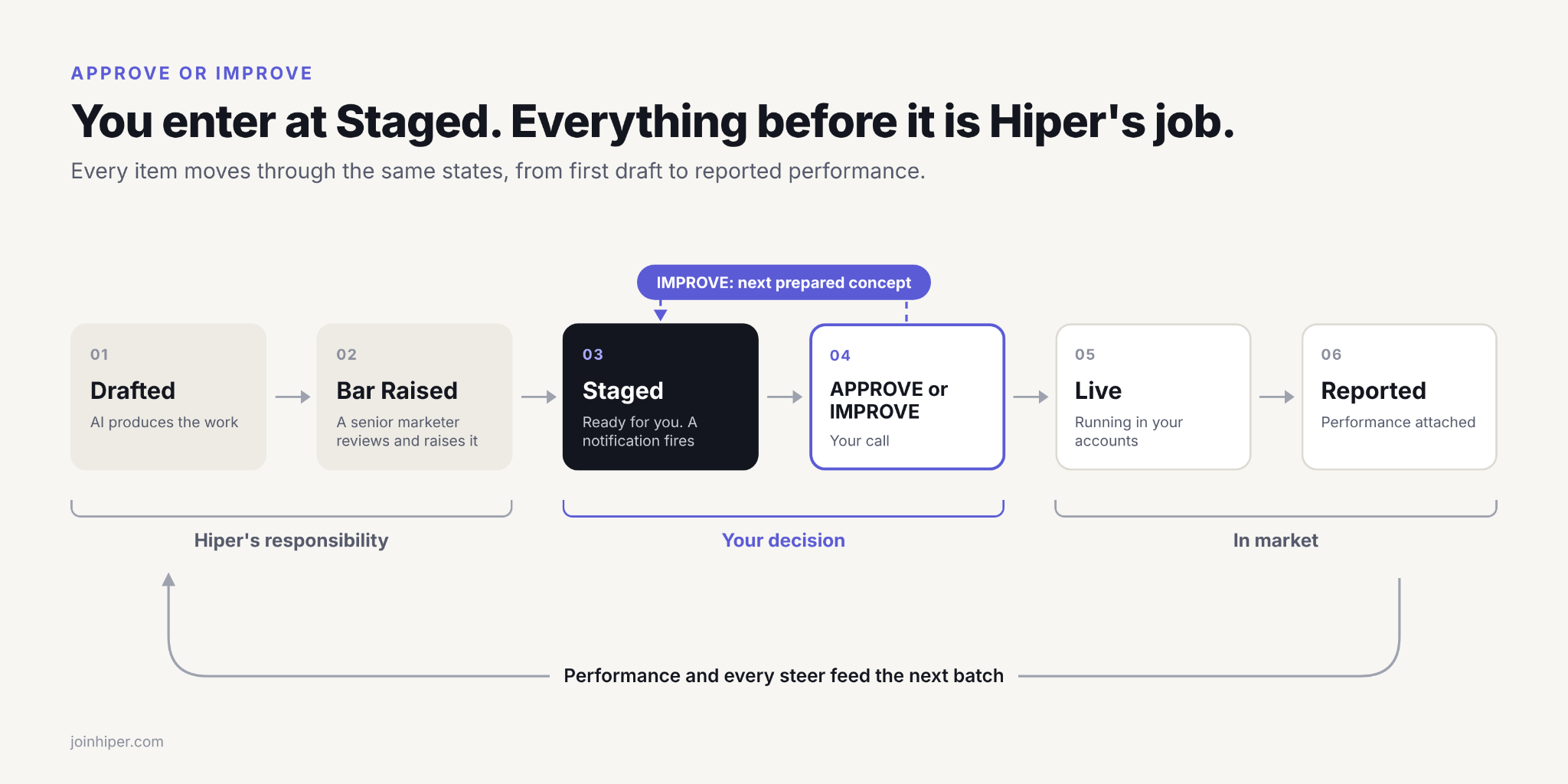
A Hiper Loop is one Buyer on one Demand Channel, always on and run as a closed-loop system. Every item in a Loop moves through the same six states:
- Drafted: AI has produced the initial work.
- Bar Raised: a senior marketer has reviewed it against the offer, the audience, and the quality standard.
- Staged: the work is ready for a client decision, and the client receives a notification.
- Approved or Improve Requested: the client accepts the work or asks for a better direction.
- Live: approved work is running in the client’s accounts or booked with the publication.
- Reported: performance data is attached for review.
The client enters at Staged. Drafts and internal revisions before that point are Hiper’s responsibility.
What the Bar Raise checks
Before an item reaches Staged, the senior reviewer checks three things:
- Claims: every claim is supported by the offer.
- Fit: the message fits the buyer.
- Call to action: the ask suits the funnel stage.
The standard is that the work is ready to run as presented.
What the client evaluates
The client’s review covers the judgment only the business holds:
- Does this reflect what our buyers care about?
- Is the positioning right?
- Would we put our name on it?
If nothing needs a decision, the Approval Queue is empty. An empty queue is a normal state, not a prompt for a status discussion.
The three-concept ladder
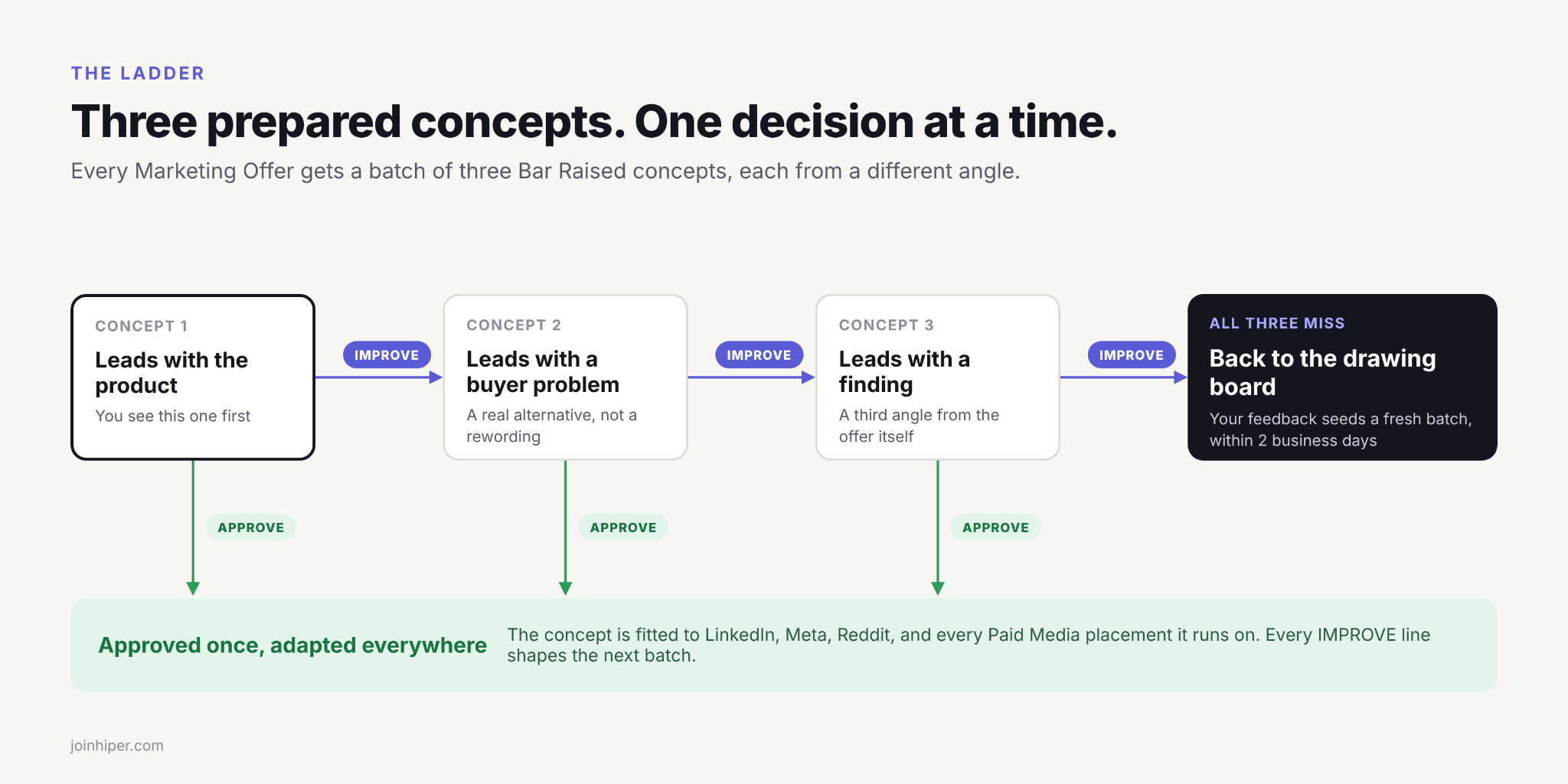
For each Marketing Offer (the report, assessment, demo, or other resource being promoted), the Loop produces three distinct ad concepts from the offer’s Master Copy. All three pass senior review before the client sees the first.
Each concept takes a different angle. If the first leads with the product, the second might lead with a buyer problem and the third with a finding from the offer.
Review follows a fixed sequence:
- APPROVE: the concept moves into deployment.
- IMPROVE: the client states what misses, ideally in one line, and the next prepared concept appears.
- All three miss: feedback is required to guide a fresh batch, which arrives within two business days.
Three points about the ladder are worth stating precisely:
- The next concept is a prepared alternative, not a revision. Feedback given on concept one does not change concept two, which already exists. It informs the next batch and becomes context for future work.
- Sequential review keeps the decision narrow. The question at each step is whether this concept is ready to represent the business. Reviewing one at a time also discourages combining fragments of several options into a new brief.
- Approval happens once per concept. Hiper adapts the approved concept to LinkedIn, Meta, Reddit, and the other paid placements in the program. The client does not approve the same idea again in each format.
Why one line of feedback is sufficient
A short instruction works when it adds to shared context. It does not work when it has to replace that context.
In a Hiper Loop, the offer, the Master Copy, the Buyer Profile, and previous feedback already exist. A line of feedback only needs to identify the gap between what the system knows and what this output missed.
Effective feedback names the problem and gives a direction. Common types:
- Emphasis: “Lead with the benchmark finding, not the product name.”
- Audience and pain point: “Too generic for platform engineers. Name the configuration drift problem.”
- Call to action: “This is a demo ask to a cold audience. Make it the report download.”
- Standing language rule: “We never use ‘revolutionary.’ Drop the superlatives.”
- Evidence: “Use the customer quote from page 4 as the proof point.”
An illustrative example: an ad opens with “Meet the next generation of infrastructure automation.” The feedback reads: “Too generic for platform engineers. Lead with configuration drift.” The next batch might open with “Configuration drift is creating work your platform team shouldn’t have to repeat.”
The useful content of that feedback is the reason behind it: this buyer needs to recognize a specific problem before hearing the product pitch. That reason applies to more than one headline.
Hiper’s senior reviewers translate each steer into instructions for future generation and review, so a steer given once applies to later work and should not need repeating. Where a lesson generalizes, the general lesson can inform other Loops while client data stays private.
Where decisions happen
Decisions are spread across three cadences:
- As work is staged: notifications arrive in Slack and in the client’s connected Claude environment through Hiper’s MCP integration. The client can review and respond there without waiting for a meeting.
- Weekly working meeting: unresolved items are reviewed alongside the Offer Progression Plan and budget. Each Staged item receives a decision or an explicit deferral. A deferral keeps the work on hold and does not count as approval. Items left unactioned for ten business days are flagged as friction.
- Monthly business review: the client decides on next month’s plan and its funding. Hiper brings a prepared recommendation, with a senior reviewer present. Budget does not move without client approval.
Performance decisions: the four calls
Hiper’s Book of Marketing Insights (BOMI) condenses performance evidence into four calls, the decisions a client makes from performance data:
- Are we reaching the right buyers? Refine the Buyer Profile.
- Should we reach new buyers or progress known ones? Adjust the balance between targeting and retargeting.
- Are we focused on the right accounts? Review the ABM lists.
- Is the creative strong enough to represent us? Approve it or direct an improvement.
Hiper translates those decisions into platform execution. For how performance evidence informs the next action, see From Attribution to Marketing Intelligence.
Approval as a control point for automation
Gartner predicts that more than 40% of agentic AI projects will be canceled by the end of 2027, citing escalating costs, unclear business value, or inadequate risk controls.
For an agentic demand program, two governance questions follow: who authorizes the work, and how is the result assessed afterward?
The workflow assigns each question a place:
- Before the client: senior review checks the work.
- At the client: approval authorizes deployment.
- After deployment: reporting attaches performance evidence to what went live.
Two limits apply. Approval is one part of risk control, not all of it. A visible decision history also does not prove that a particular choice caused a business result. What it does provide is an inspectable record: what was approved, what ran, how it performed, and what should change next.
Implications for marketing teams
The practical change is not fewer comments on drafts. It is a different allocation of senior time.
Time that went to rebuilding briefs and checking revisions moves to buyer needs, positioning, offer quality, and performance. The team still shapes the program, through decisions that Hiper executes and learns from.
This is also why the Marketing Offer is the unit of modern demand. A faster production process has limited value if the offer gives buyers no reason to act. Recovered time is best spent creating stronger reasons, and putting them in front of the targeted buyers who need to see them.
In summary: APPROVE authorizes deployment of prepared work. IMPROVE records why a concept misses and directs what comes next. The production between those two decisions is Hiper’s responsibility.

