What Should AI Do in Marketing, and What Should Humans Still Own?
A senior marketer opens an AI-generated campaign draft. The copy is polished. The variations are ready. Every asset follows the requested format. But the campaign leads with a product feature that buyers have little reason to care about.
Producing more versions will not solve that problem. Someone has to recognize that the direction is wrong, explain why, and decide what deserves the team’s attention instead.
That is the useful starting point for AI in marketing. Asking whether AI can do marketing treats a whole discipline as a single task. The better question is which work benefits from automation, where experienced judgment changes the outcome, and who stays accountable for the decisions.
Most teams have not drawn that line yet. A Gartner survey of 418 marketers found that 77% of marketers explore GenAI, but only 44% realize significant benefits. Access to the tools is not the gap. The division of work is.
Hiper’s view is that AI should carry the production workload while excellent marketers set direction, raise the quality, and make consequential decisions. Making that model work takes more than adding a human approval step. It takes a deliberate division of responsibility.
Give AI work that benefits from speed and repetition
A demand program contains a large amount of work that gets easier when a system can process information, apply a defined instruction, and repeat the task consistently. That is where AI belongs, fed with the right source material and checked before anything ships.
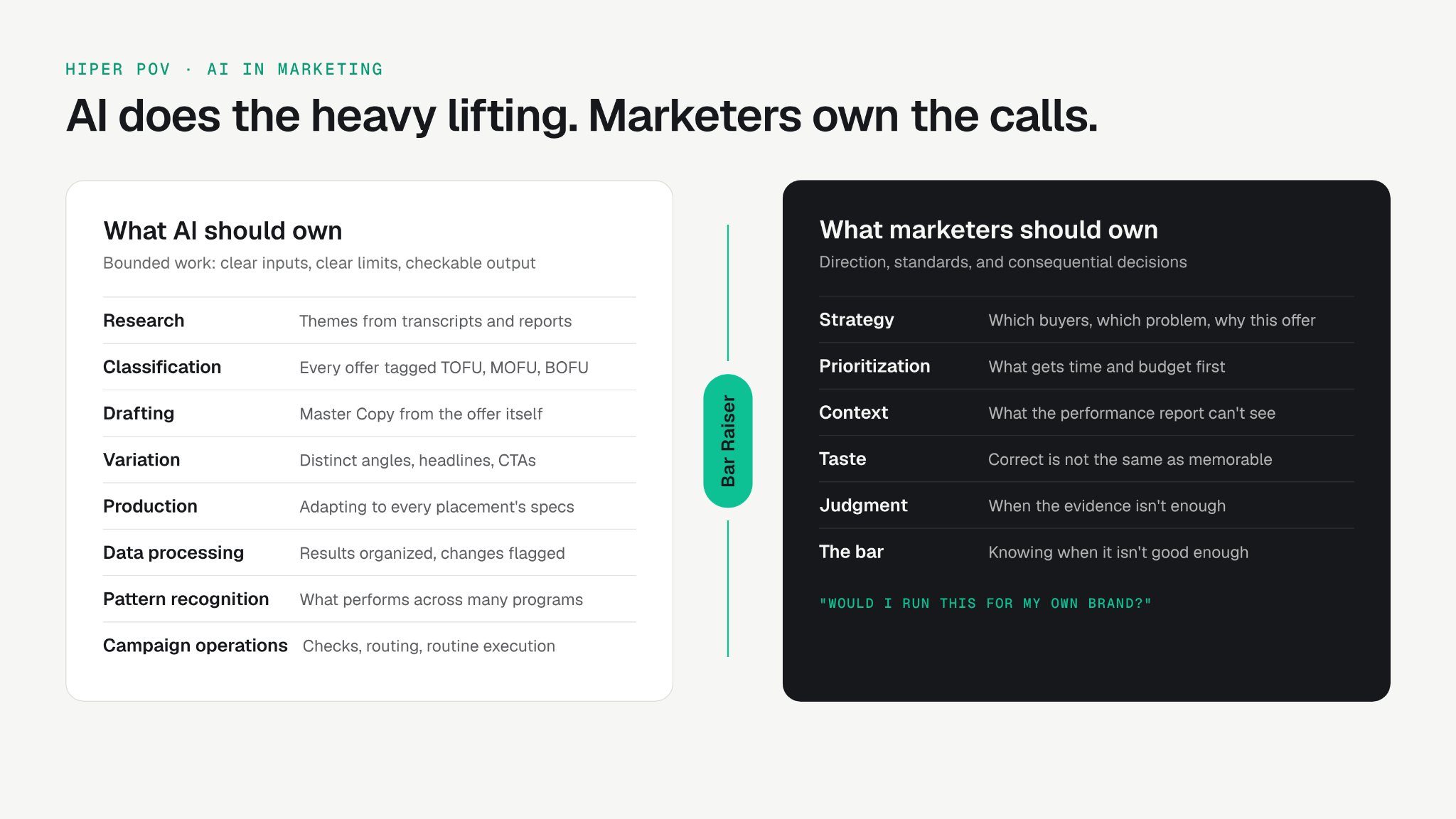
Research and classification come first. AI can organize interview transcripts, extract themes from supplied reports, group accounts against defined criteria, and classify every Marketing Offer by funnel stage. The output should keep its sources, so the reviewer can separate evidence from an unsupported interpretation.
Drafting and variation build on that foundation. Given an approved offer, a Buyer Profile, and clear constraints, AI can prepare distinct message angles, headlines, and calls to action. The experienced marketer evaluates options instead of writing every first draft.
Production turns approved direction into usable assets. Adapting copy to each placement’s specs, preparing format variations, and checking for missing components all belong to the system once the rules are explicit. The system also has to flag any change that alters the meaning or exceeds the approved direction.
Data processing and pattern recognition make performance easier to investigate. AI can organize campaign results, highlight changes, and surface patterns that deserve attention, including which placements perform across many programs. A change in response rate is a reason to ask questions. It is not, by itself, an explanation of what caused the change.
Campaign operations are the last piece. Defined checks, status updates, routing, and routine execution can run within agreed permissions. Anything with material consequences, such as moving budget or changing a claim, needs a named person to authorize it. The cost of skipping that step is real: Forrester predicts B2B companies will lose more than $10 billion in enterprise value because of ungoverned use of generative AI.
The common feature is bounded work. The inputs, objective, and limits can be stated, and the output can be checked. The clearer the boundaries, the more you can delegate.
Keep people accountable for direction and judgment
Automation can prepare work and inform decisions. Marketing leaders still own what the program is trying to accomplish and the tradeoffs it makes along the way.
Strategy establishes which buyers matter, what problem the business can credibly help them solve, and why an offer deserves attention. Prioritization decides which opportunity gets time and funding when several look promising. Neither is fulfilled by generating a longer list of possibilities.
Context changes how evidence should be read. A campaign may need to reflect a sales conversation, a product limitation, or a shift in the company’s positioning that never shows up in the performance report. Experienced marketers identify that missing context and bring it into the decision.
Taste matters because technically correct work can still be forgettable. A headline can meet the brief and sound like every competitor. A design can follow the brand guidelines while burying the most useful information. A reviewer has to recognize those weaknesses and say what would make the work stronger.
Judgment brings these responsibilities together. It means knowing when the evidence is insufficient, when a promising idea should wait, and when something simply is not good enough to represent the business.
AI can contribute to each of these. It can challenge an assumption, compare strategic options, or spot an inconsistency. Human ownership means an accountable person weighs that contribution and makes the call.
Why Hiper uses a Bar Raiser
If AI produces faster than people can assess the work, the review queue becomes the new bottleneck. The client’s senior marketer ends up correcting generic copy, checking basic claims, and explaining the audience again. Production has accelerated, and the burden on the client has grown.
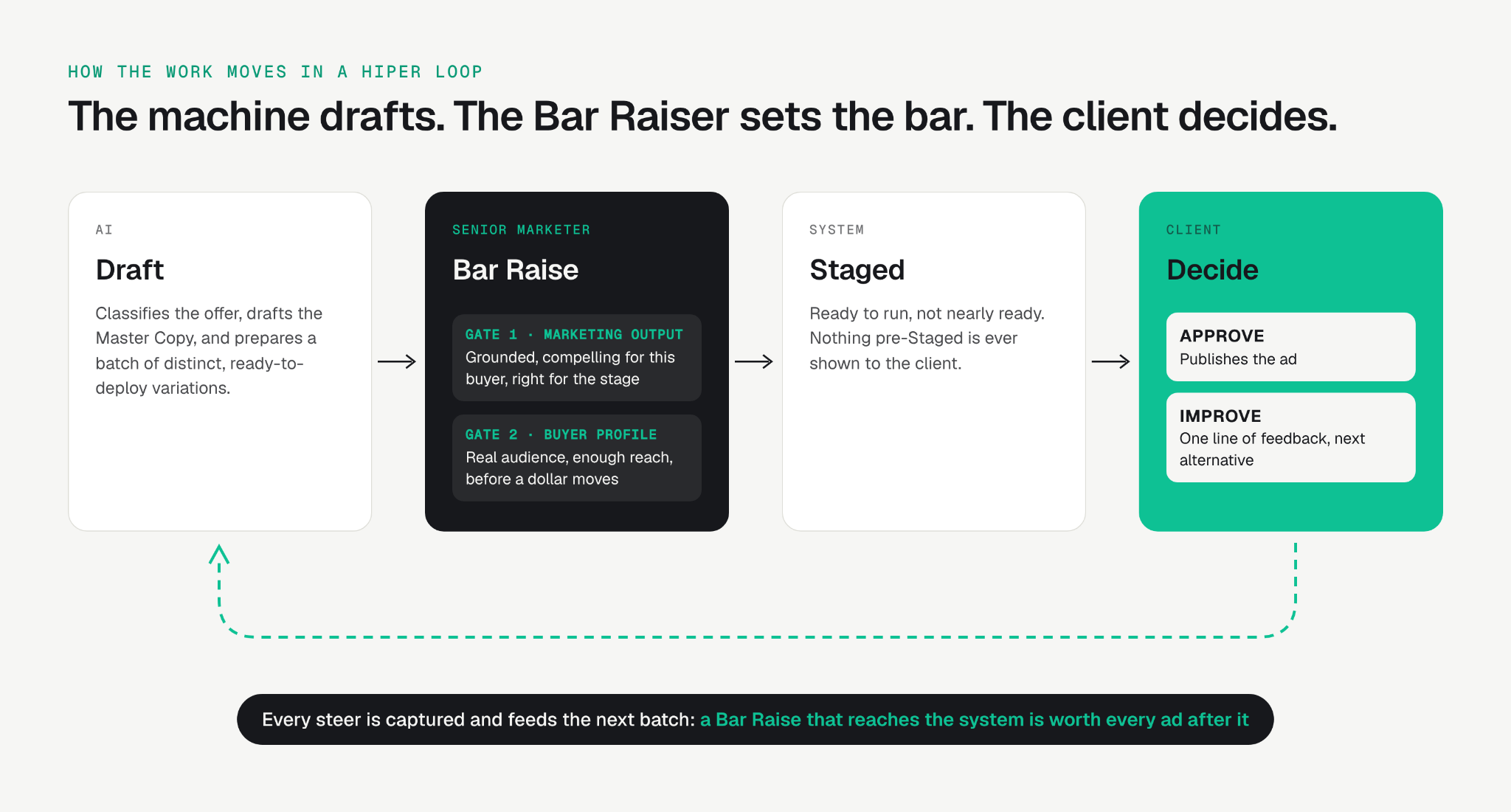
Hiper’s Bar Raiser puts an experienced marketer in charge of quality before work reaches the client. In a Hiper Loop, AI drafts the Marketing Output and a senior marketer Bar Raises it before it is Staged for a client decision. Nothing passes on a machine’s judgment alone.
That review asks whether the work deserves to advance:
- Is every claim traceable to what the offer actually says?
- Does the message speak to what makes this specific buyer act?
- Is the idea specific and credible enough to earn attention?
- Does the call to action fit the funnel stage?
- Would I run this for my own brand?
The last question is the one a rubric cannot automate. It catches work that is accurate, on-brand, and still flat. A draft that fails it goes back before the client sees it. The Bar Raiser must be able to reject a direction, not merely polish its wording.
Consider an ad promoting a report to platform engineers. The draft opens with “Meet the next generation of infrastructure automation.” It is grammatically sound, and it gives the buyer no reason to continue.
If the report contains evidence about configuration drift, the reviewer redirects the work toward that problem and requires a relevant proof point. If the report does not support that angle, the reviewer finds a defensible alternative. A stronger-sounding headline cannot make up for missing evidence.
The Bar Raiser holds a second gate as well: the Buyer Profile and its targeting, reviewed before a dollar moves. Are the titles and industries real, and is there enough live audience behind them to run? That is context and judgment applied before spend, not after.
The value lies in diagnosing what the work missed and choosing a better direction. AI then does the production needed to express that direction clearly.
Make client decisions consequential
The Bar Raiser does not replace the client’s judgment. It makes better use of it.
Hiper’s job is to deliver work that is ready to run. The client brings the business context needed to assess positioning, buyer relevance, and whether the company should put its name behind the concept. The client approves the plan, and budget never moves without them.
That is why the client’s side of the review comes down to two words: APPROVE or IMPROVE. APPROVE publishes the ad. IMPROVE takes one line of feedback, moves to the next Bar-Raised alternative, and carries the steer into the next batch. The client makes decisions, not corrections.
Those two words only work because the heavy lifting happened before the decision. A simple interface cannot make an underprepared campaign ready to run.
The same principle applies to performance. AI prepares the evidence and flags changes. Experienced marketers decide whether the next action should address the audience, the offer, the creative, or another part of the program, and the system turns that decision into execution. Our piece on moving from attribution to marketing intelligence covers how to read that evidence.
Make feedback improve the next cycle
A short instruction works when it adds to shared context. “Lead with the benchmark finding” is enough when the offer, audience, evidence, and previous decisions are already available.
It is wasted if that instruction disappears into a document comment. In Hiper’s model, Bar Raisers capture every steer and feed it back into how the next batch is generated and reviewed. A Bar Raise that fixes one ad is worth one ad. A Bar Raise whose steer reaches the system is worth every ad after it.
The reason behind the feedback matters as much as the wording change. “This audience needs to recognize the operational problem before hearing the product pitch” gives future work a principle to apply. It also takes judgment to apply it: a lesson from one audience or offer should not become a universal rule without checking that the context still fits.
This is where the model compounds. Over two years, Hiper has shipped continuous improvements that raise Marketing Output efficiency and quality by 15% at a time, and five of those compound to better than 2x.
The test is whether the same avoidable mistake keeps coming back. If the client corrects the same issue twice, the steer did not reach the system.
Measure the model by the work it enables
More assets and faster drafts are useful operational measures. They do not prove that a demand program is making better decisions.
Track three things alongside them: how much work reaches review ready to run, how often feedback has to be repeated, and how much senior time is left for buyer insight, offer quality, and strategy. Performance evidence then shows whether those decisions are producing results.
That is the division of work Hiper advocates and the core of agentic demand marketing: AI handles the heavy production workload, experienced marketers raise the standard, and clients keep authority over consequential business decisions.
The capacity gained gives the team room for the work that used to get crowded out: understanding buyers more deeply, building stronger offers, and deciding what deserves to go into the market.

